November 17, 2026
Generative Engine Optimization for Local Businesses: How to Get AI to Recommend You
Generative engine optimization for home service businesses: the three things ChatGPT, Gemini and Google AI reward, and the GEO tactics that are pure hype.
Part of our guide: how to show up in chatgpt
TL;DR: Generative engine optimization (GEO) is the work of getting AI tools like ChatGPT, Gemini and Google’s AI Overviews to name your business in their answers. For a local home service business, it comes down to three things: facts that match everywhere, pages that answer the exact question a homeowner asks, and proof from other sites. Google says it’s still SEO. Do the basics right and you win both.
Picture this. A homeowner’s AC dies on a Friday night. They don’t scroll ten blue links. They open ChatGPT or ask Google and get back three names. If you’re one of them, you get the call. If you’re not, you never knew the job existed.
That’s already happening. In BrightLocal’s 2026 consumer survey, the share of people using ChatGPT and other AI tools to find local business recommendations jumped from 6% to 45% in one year.
So now every agency is selling “GEO.” It sounds technical and expensive. It isn’t. Once you strip out the buzzwords, AI engines reward the same things a smart homeowner looks for: a business whose details check out, a website that answers the question, and other people vouching for it.
This post breaks down what GEO really means for a plumber, an HVAC company or a roofer, where AI tools pull their local data from, and which tactics are worth your time. This is part of our guide to how to show up in ChatGPT.
What is generative engine optimization (GEO)?
Generative engine optimization is the practice of making your business easy for AI tools to find, trust and quote, so ChatGPT, Gemini, Perplexity, Claude and Google’s AI Overviews name you when someone asks for a local pro. Classic SEO aims for a blue link. GEO aims for a mention inside the answer.
The term comes from a 2023 research paper by a team of computer scientists, later accepted at the KDD 2024 conference. They tested ways to make web pages show up more often in AI answers and reported visibility gains of up to 40%. Adding citations, quotes from credible sources and real statistics were among the methods that helped most.
For a local business, I boil GEO down to three jobs:
- Facts that match everywhere. Your name, address, phone, hours and services read the same on your website, your Google Business Profile, Bing, Apple, Yelp and Facebook.
- Pages that answer the exact question. One clear page per service, written the way homeowners ask.
- Proof from other sites. Reviews, local news, “best of” lists and trade associations that mention you by name.
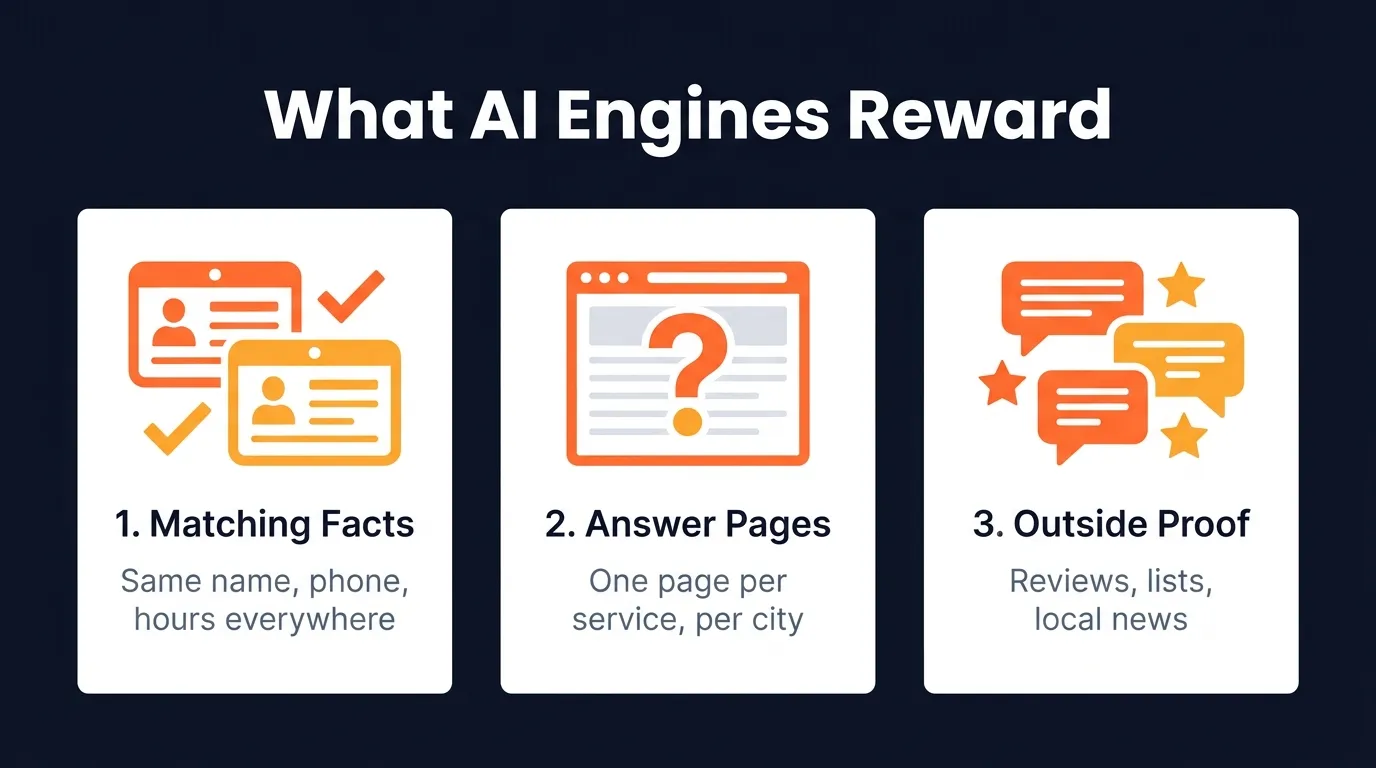 The three GEO jobs for a local home service business.
How is GEO different from SEO for a local business?
GEO and SEO are mostly the same work for a local business. Google’s own guide says “optimizing for generative AI search is optimizing for the search experience, and thus still SEO.” The difference is the finish line: SEO wins a ranking spot, while GEO wins a named recommendation inside an AI answer.
That quote comes from Google’s May 2026 guide, Optimizing your website for generative AI features on Google Search. Its older help page on AI features and your website is just as blunt: “There are no additional requirements to appear in AI Overviews or AI Mode, nor other special optimizations necessary.” A page just has to be indexed and eligible to show in Search with a snippet.
Here’s where the two do split apart:
| Classic local SEO | GEO (AI answers) | |
|---|---|---|
| Goal | Top 3 on the map, page one organic | Named in the AI’s short list |
| Who reads your page | A person skimming | A model pulling facts to summarize |
| Biggest lever | Profile, distance, reviews, links | Matching facts, clear answers, outside mentions |
| Where you check | Google Maps and search results | ChatGPT, Gemini, AI Overviews, AI Mode |
| How many winners | 3 map spots plus 10 links | Often 2 to 5 names |
The last row is the one that matters. Fewer names make the cut. SOCi’s 2026 Local Visibility Index, which looked at more than 350,000 business locations, found ChatGPT recommends just 1.2% of them. That’s a small club. The upside is that most of your competitors aren’t even trying yet.
If you want the wider picture of how AI fits into your marketing, read our breakdown of AI SEO for home service businesses.
Which sources do AI engines trust for local businesses?
AI engines lean on your Google Business Profile, your own website, and big directories like Yelp and Facebook. BrightLocal’s study of about 200,000 local AI searches found business websites made up 42% of all citations and Google Business Profiles 28.6%, with Yelp next at roughly 9.5%.
That’s from BrightLocal’s Local AI Visibility Study, which tracked ChatGPT, Google AI Mode and Google AI Overviews over 60 days. A few findings every owner should know:
- Google’s AIs run on your profile. BrightLocal called the Business Profile “by far, the most important source of information,” especially for AI Mode and AI Overviews.
- ChatGPT is different. It “hardly” uses Google Business Profiles and leans more on Yelp and Bing. So your Bing listing matters more than you think. Claim it at Bing Places and match it to your Google profile.
- The engines don’t agree. Google’s two AI tools shared only 29.3% of the businesses they named. ChatGPT overlapped with either one only about 19 to 20% of the time. Showing up in one doesn’t mean you show up in all of them.
- Storefronts get a small edge. Locations with a public address were mentioned 33.6% of the time versus 29.4% for service-area businesses.
That last point ties into the biggest lever we pull for clients. Every real, staffed office should have its own profile, its own phone number and its own page. That’s how a business shows up on the map, and in AI answers, across more than one city. We walk through the setup in how to launch multiple Google Business Profiles.
When we pull up a new home service client in ChatGPT and Google AI Mode side by side, the gaps almost always trace back to mismatched facts. An old phone number on Yelp. A Bing listing nobody claimed. A service on the website that’s missing from the profile. Fix the facts first. It’s the cheapest GEO work there is, and it’s usually the most overdue.
How do you write pages that AI engines quote?
Write one page per service per city, and open every section with a direct, plain answer to the question a homeowner would type, followed by specifics like prices, timelines, brands and service areas. AI tools lift clear, self-contained sentences. Vague marketing copy gives them nothing to quote.
Whitespark’s 2026 Local Search Ranking Factors survey added AI search visibility as a brand-new category this year. The number two factor on that list: a dedicated page for each service. One “Services” page with ten bullet points won’t cut it.
Here’s the page formula we use:
- Name the service and city in the heading. “Water heater replacement in Mesa,” not “Our Services.”
- Answer the money questions up top. How fast can you come out? Do you work weekends? Do you handle insurance? What brands do you install?
- Add real numbers you can stand behind. Years in business, license number, typical job length, warranty terms. The GEO paper found stats and citations helped pages get picked up. Only use numbers that are true.
- Show first-hand proof. Google’s guide says it values content that “provides unique expert or experienced takes that go beyond common knowledge.” Photos from real jobs, a tech’s tip on what causes the problem, a story from the field.
- Use a simple FAQ. Five or six questions a customer actually asks your office staff.
Think about how it plays out across trades. A roofer’s “storm damage roof repair in Plano” page should say what to do in the first 24 hours, whether they work with insurance adjusters, and how fast they can tarp. An HVAC company’s “AC repair in Scottsdale” page should cover same-day service, which brands they fix, and what a diagnostic costs. That’s what the AI is hunting for.
You don’t need special tricks to make this machine-readable. Google’s guide says “You don’t need to write in a specific way just for generative AI search.” Clear writing for people is clear writing for AI. For the full page and site setup, see our guide to local SEO for contractors.
How do you get other sites to vouch for your business?
Earn mentions on sites AI already trusts: steady Google reviews, a complete Yelp and Facebook presence, local “best of” lists, trade associations, supplier dealer pages, and local news. AI tools treat these third-party mentions as proof that you’re real, active and good at the work.
The data here is strong. In Whitespark’s 2026 survey, the number one AI visibility factor was being on expert-curated “best of” lists. Others in the top five were prominence on key industry sites and mentions in newspapers, blogs, government sites and industry associations. Whitespark put it simply: “In AI SEO, mentions (citations) are the new link.”
Ahrefs studied 75,000 brands and found the same pattern. Mentions of a brand across the web correlated with showing up in AI Overviews about three times more strongly than backlinks did (0.664 versus 0.218). It’s a correlation, not proof of cause, but it points the same direction as everything else.
Here’s where a home service business can earn those mentions:
- Reviews, every week. Ask after every finished job, by text, while the customer is still happy. A steady flow beats a burst. BrightLocal found 82% of consumers read AI-generated review summaries, so what customers say in reviews becomes part of how AI describes you.
- Supplier and manufacturer pages. Plumbers, HVAC shops and roofers often qualify for “find a dealer” or certified installer listings. Those are strong, trusted mentions.
- Trade associations and the chamber. A member listing with your exact name, address and phone.
- Local news and sponsorships. Sponsor a youth team, help after a storm, get quoted in a local story.
- Local “best of” lists. Many cities have them. Get nominated, and ask happy customers to vote.
 Every finished job is a chance to earn a review, and reviews are proof AI engines can read.
One warning that’s really a tactic: keep it real. Google’s guide says “seeking inauthentic ‘mentions’ across the web isn’t as helpful as it might seem.” Paid link farms and fake reviews put your profile at risk. Real jobs, real customers and real community work are the safe way to build proof, and they’re the kind AI tools keep trusting.
What GEO tactics are hype, and which actually work?
The tactics that work are the boring ones: matching business facts, a complete Google Business Profile, a page per service, steady reviews and real mentions on trusted sites. The hype tactics are AI-only files, special “AI schema,” chopping content into tiny chunks, and buying mentions. Google’s own guide calls most of those unnecessary.
Here’s a quick sort:
| Tactic | Verdict | Why |
|---|---|---|
| Matching name, address, phone and hours everywhere | Works | AI tools cross-check facts across sources |
| Complete, active Google Business Profile | Works | Top source for Google’s AI answers |
| Claimed Bing Places listing | Works | ChatGPT leans on Bing |
| One page per service, per city | Works | Number two AI factor in Whitespark’s 2026 survey |
| Steady weekly reviews | Works | Feeds the AI review summaries buyers read |
| Real mentions on lists, news, associations | Works | Top AI factors in Whitespark’s survey |
| Standard schema markup (LocalBusiness, FAQ) | Useful | Helps search engines read your facts; Google says no special AI schema exists |
| llms.txt file | Nice to have | Google says you don’t need one; takes minutes, so it’s not worth paying extra for alone |
| Chopping pages into tiny chunks | Hype | Google says there’s “no requirement to break your content into tiny pieces” |
| Rewriting everything “for AI” | Hype | Google says write for people |
| Buying mentions or fake reviews | Risky | Google says inauthentic mentions don’t help as much as you’d think |
Google’s mythbusting section is clear on llms.txt and special files: “You don’t need to create new machine readable files, AI text files, markup, or Markdown to appear in Google Search.” We still add an llms.txt for clients because it costs nothing and some AI tools may read it. But it isn’t what gets you recommended. Matching facts, strong pages and outside proof do that.
Then check your work. Once a month, open ChatGPT, Gemini and Google AI Mode and ask the questions your customers ask: “best plumber in [city],” “emergency AC repair near [neighborhood],” “who fixes roof leaks in [city].” Write down who gets named and what sources show up. If a competitor keeps appearing, look at where they’re mentioned that you’re not. Our post on how to rank in multiple cities on Google Maps covers the street-by-street tracking side.
Want to see where you show up in AI search today?
The fastest way to know where you stand is to check your business live in Google Maps, ChatGPT and Google’s AI answers, then compare your listings for mismatched facts. That one check shows you which of the three GEO jobs to fix first.
That’s exactly what we do on a strategy call. We pull up your business live and show you where it ranks on the map and what AI tools say about you today. Then we show you how Ignite runs the whole system for you: a page for every service in every city, every Google Business Profile managed, a steady flow of reviews, listings that match across Google, Bing, Apple and the major directories, and schema on every page.
You run the business and take the calls. We handle getting you named.
Book a Strategy Call and see where you stand.