November 3, 2026
AI SEO for Home Service Businesses: How to Become the Pro ChatGPT and Google AI Recommend
AI SEO for plumbers, HVAC companies and roofers: what ChatGPT, Gemini and Google AI check before they recommend a pro, a 7-day fix list, and how to track it.
Part of our guide: how to show up in chatgpt
TL;DR: AI SEO for a home service business means making your company the easiest one for ChatGPT, Gemini, Perplexity and Google’s AI answers to verify and recommend. There is no secret file or trick. It is the same facts everywhere, one clear page per service and city, a strong Google Business Profile, and a steady flow of reviews that say what you did and where. Fix the basics this week, then track AI mentions every month.
Picture a homeowner in Phoenix whose AC quit at 9 p.m. A year ago she typed “AC repair near me” into Google. Tonight she asks ChatGPT, “Who can fix my AC tonight in Phoenix?” and it names three companies.
If you are one of the three, you get the call. If you are not, you never knew the job existed.
That shift is real. In BrightLocal’s 2026 consumer survey, the share of people using ChatGPT and other AI tools for local business recommendations jumped from 6% to 45% in a single year. And 42% of consumers in that survey said they trust AI recommendations as much as traditional reviews.
So “AI SEO” is now the hottest pitch in the agency world. Some of it is useful. A lot of it is a new label on old work, sold at a markup.
This post cuts through it. You will learn what AI SEO actually is for a plumber, HVAC company or roofer, what AI checks before it names a pro, a 7-day fix list, how to track results for free, and how to tell if paying for it is worth it. This is part of our guide to how to show up in ChatGPT.
What is AI SEO for a home service business?
AI SEO for a home service business is the work of getting ChatGPT, Gemini, Perplexity and Google’s AI Overviews to name your company when a homeowner asks for a pro. It means publishing clear, consistent facts about your services, cities, reviews and contact details everywhere these tools look, so they can verify you and feel safe recommending you.
You will also hear it called GEO (generative engine optimization) or AEO (answer engine optimization). Same idea, different acronym.
Here is the key thing to understand. An AI assistant answering a local question is not guessing. It runs searches behind the scenes, reads your website, your Google profile, review sites and directories, then writes an answer from what it found. Google even names this process: its AI Overviews and AI Mode may run “multiple related searches across subtopics and data sources” to build one answer.
So AI SEO is about being the business that shows up clearly and consistently in all of those searches at once.
How is AI SEO different from regular SEO?
AI SEO is built on regular SEO, not instead of it: the same crawlable site, service pages, Google profile and reviews still do the heavy lifting. The difference is the finish line. Regular SEO wins a ranking slot. AI SEO wins a mention inside a written answer, which depends more on your facts agreeing across many sources.
Google says it plainly. There are “no additional requirements to appear in AI Overviews or AI Mode, nor other special optimizations necessary”. If your page is indexed and eligible to show in normal search, it is eligible for Google’s AI features.
But the competition is much tighter. SOCi’s 2026 Local Visibility Index looked at roughly 350,000 locations from 2,751 multi-location brands. Those locations showed up in Google’s local 3-pack 35.9% of the time on average. ChatGPT recommended just 1.2% of them, Gemini 11% and Perplexity 7.4%. Those were bigger brands, not local trades, but the lesson carries: AI names far fewer businesses than the map does.
| Regular local SEO | AI SEO | |
|---|---|---|
| The prize | A spot in the map pack or blue links | A name in the written answer |
| How many win | 3 map spots plus 10 links | Often 1 to 3 businesses |
| What decides it | Relevance, distance, prominence | Whether many sources agree you are the right pick |
| Biggest lever | Google Business Profile and service pages | Same, plus mentions, reviews and directories that match |
| How you measure | Rankings and calls | AI mentions, citations and referral visits |
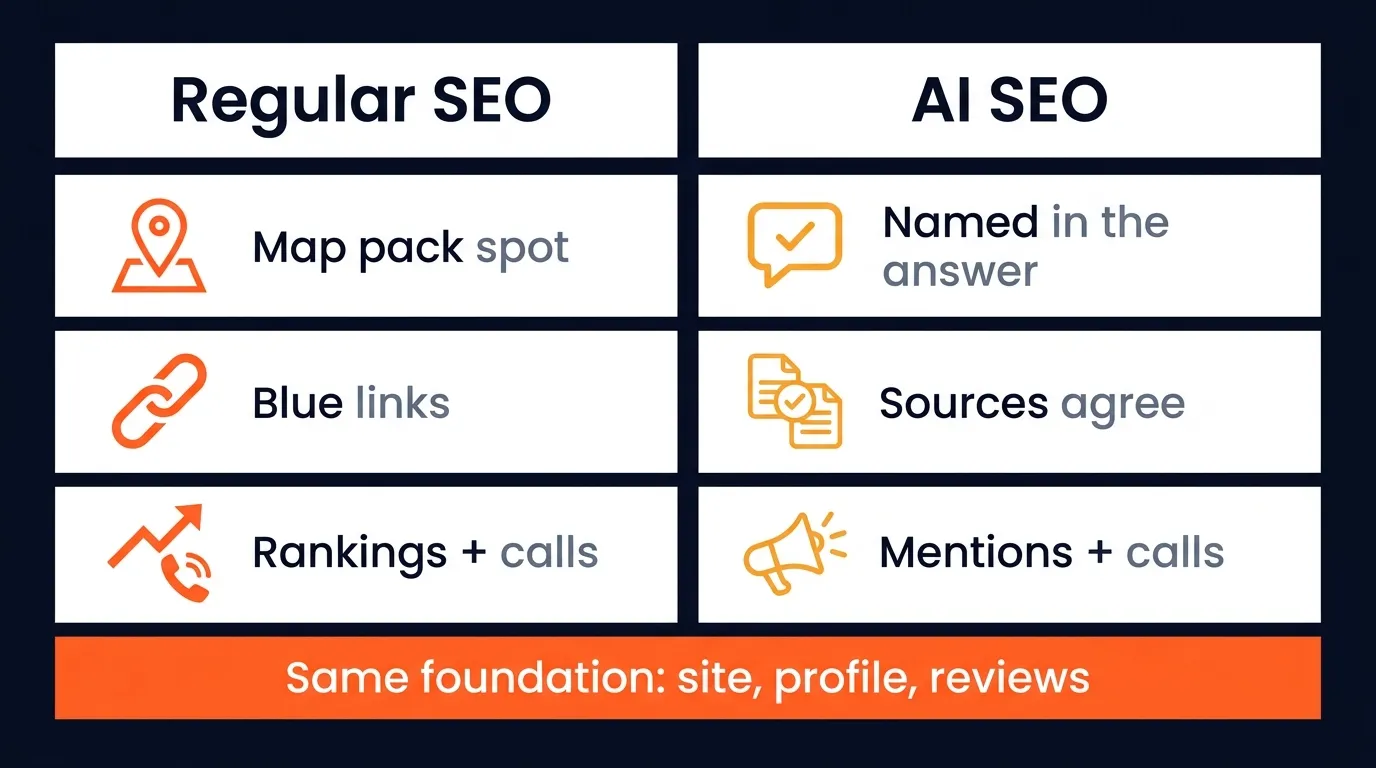 Same foundation, tighter finish line.
The good news for owners: the work overlaps almost completely. If you are already doing local SEO for contractors well, you are most of the way there.
What do AI assistants look at before they recommend a business?
AI assistants look at your Google Business Profile, your own website, review sites like Yelp, and mentions of your business on other sites, then recommend the pros whose name, services, location and reviews line up across those sources. For local trades, your Google profile is usually the single biggest source they cite.
BrightLocal’s August 2026 study of nearly 2 million AI citations broke out plumbers. Google Business Profile made up 54% of all plumber citations, Yelp 13.8%, Facebook 3.1%, Angi 2.2% and HomeAdvisor 0.9%. Across every industry, about 93% of the cited domains were individual business websites.
Here is what that means in practice, source by source:
- Your Google Business Profile. Categories, services, service areas, hours, photos and reviews. Google’s own AI guidance tells businesses to keep their Business Profile information up to date. Our Google Business Profile guide for contractors covers every field.
- Your website. One page per service and city, with plain facts in plain text. A roofer with a “storm damage roof repair in Plano” page gives the AI an exact match to quote.
- Reviews. Not just stars, the words. SOCi found that the locations ChatGPT recommended averaged a 4.3 star rating. A review that says “they fixed our tankless water heater same day in Frisco” tells AI your service, your speed and your city in one line.
- Mentions on other sites. Ahrefs studied 75,000 brands and found branded web mentions had the strongest link to showing up in AI Overviews, with a correlation of 0.664 versus 0.218 for backlinks. That is correlation, not proof, but it points the same way: the more places that talk about you, the more confident AI gets.
When owners ask us about AI SEO, they usually expect us to install some new tool. Then we run the audit together. We ask ChatGPT who the best water heater pro in their town is, and it names a competitor. We look at why. Almost every time, the competitor is not doing anything clever. They just have more reviews that mention the service and the city, the same phone number on every directory, and a page for the exact job the homeowner asked about. In my years as a restoration technician, homeowners in a flooded basement never did deep research. They called the first name they trusted. AI works the same way, and trust comes from consistency.
What can you fix this week to show up in AI answers?
You can fix the five things AI checks first in a single week: let AI crawlers into your site, make your name, address and phone identical everywhere, fill out every Google profile field, give each money service its own page, and start asking every happy customer for a detailed review. None of it requires new software.
Here is the 7-day sprint I would give any plumber, HVAC company or roofer.
- Day 1: Open the doors. Check yoursite.com/robots.txt. OpenAI says sites that block OAI-SearchBot will not show in ChatGPT search answers. Some website builders and security plugins block AI bots by default. Make sure Googlebot and Bingbot are allowed too.
- Day 2: Ask AI about yourself. Ask ChatGPT, Gemini and Perplexity “What do you know about [business name] in [city]?” Write down every wrong phone number, old address or missing service. That is your fix list.
- Day 3: Clean up your listings. Make your business name, address and phone match exactly on Google, Bing Places, Apple Business Connect, Yelp, Facebook, the BBB and your trade directories. One conflict is enough to make AI pick someone else.
- Day 4: Max out your Google profile. Right primary category, every relevant secondary category, every service listed with a short description, accurate service areas, fresh job photos. If you run more than one office, each real location needs its own profile; here is how to launch multiple Google Business Profiles the right way.
- Day 5: Build or fix your top three service pages. Pick the jobs that pay the most. An HVAC company might choose heat pump installation, AC repair and furnace replacement. Each page states the service, the cities you cover, your hours, emergency availability and license number in plain sentences.
- Day 6: Add schema markup. LocalBusiness structured data states your name, address, phone and hours in a format machines read. Google’s rule is simple: everything in your markup should also be visible on the page. Schema is not a ranking hack. It is consistency, written in code.
- Day 7: Turn on a review habit. Ask every happy customer, the day the job is done, to describe the work in their own words. Details like the service and the neighborhood happen naturally when you ask right after the job.
 Fresh job photos and detailed reviews give AI proof you do the work, where you say you do it.
A note on llms.txt: it is a cheap, optional fact sheet for AI tools, but Google says you do not need AI text files to show up in its AI features. Add one if it is easy. Do not let anyone sell it to you as the secret.
How do you track whether AI recommends you?
You track AI visibility with a monthly prompt audit across ChatGPT, Gemini, Perplexity and Google AI Mode, plus three free data sources: Google Search Console, Bing Webmaster Tools’ AI Performance report, and the chatgpt.com referrals in your analytics. Watch the trend over months, because single AI answers change from run to run.
Here is the tracking setup we recommend:
- Monthly prompt audit. Write 10 questions your customers really ask: “emergency plumber in Tacoma,” “who installs metal roofs near Boise,” “best HVAC company in Mesa.” Ask each assistant from inside your service area. Record whether you appear and which sources it cites.
- Bing Webmaster Tools. Microsoft launched an AI Performance report in February 2026 that shows when your pages are cited in Copilot and Bing’s AI answers. In June it added intents, topics and citation share views. It is free, and it shows real citation counts, which Google does not break out yet.
- Google Search Console. Traffic from AI Overviews and AI Mode is counted in the Performance report under the “Web” search type. You cannot split it out, but you can watch impressions and clicks on your service pages.
- Analytics referrals. OpenAI says ChatGPT adds utm_source=chatgpt.com to links it sends, so those visits show up by name in Google Analytics.
- Calls, not just clicks. Google suggests judging AI traffic by conversions like inquiries, not raw clicks. For a home service business, that means calls and booked jobs. Use call tracking numbers so you know which channel each call came from.
And answer every one of those calls. My uncle once lost an $80,000 job over one missed call, and no amount of AI visibility fixes a phone that rings out.
Is AI SEO worth paying for?
AI SEO is worth paying for when it is part of a complete local program: a page for every service and city, Google profile management, review generation, consistent listings and real tracking. It is not worth paying for as a separate add-on that sells a file, a prompt trick or a report without fixing the sources AI actually reads.
Here is a quick test for any agency pitching you AI SEO:
| Ask them | Good answer | Red flag |
|---|---|---|
| What exactly will you change? | Pages, listings, profile, reviews, schema | ”Our proprietary AI method” |
| How will I see results? | Monthly prompt audits, Bing AI citations, calls | Vague “visibility score” only |
| Do you guarantee I show up in ChatGPT? | No, nobody controls that | Yes |
| Does this replace my local SEO? | No, it builds on it | Yes, SEO is dead |
| Will you fix my Google profile and reviews? | Yes, that is the core | That is a separate package |
The math is simple: weigh the monthly cost against what one extra water heater install, roof replacement or HVAC system is worth to you. The question is not whether AI search matters. With 45% of consumers already using AI for local recommendations, it does. The question is whether you are paying for work that feeds every source at once, or for a buzzword.
If you want the bigger picture on budgets and channels, our guide to home service marketing breaks down where the money goes.
See what AI says about your business today
AI SEO is not a new game. It is the local SEO game, played across more sources, with less patience for messy data. The pros who win are the ones whose facts line up everywhere.
That is how we built Ignite. Every client gets a custom site with a page for every service in every city, schema markup on every page and an llms.txt file. We manage every Google Business Profile, run automatic review requests after each finished job, and keep listings and citations consistent across Google, Bing, Apple and the major directories, so ChatGPT, Gemini, Perplexity and Claude can verify and recommend the business. Call tracking and street by street rank tracking show what is working, and a 24/7 AI receptionist answers every call.
No one can honestly promise you a spot in an AI answer. We control the work, and we show you every page, post, ranking and call.
Book a Strategy Call and we will pull up your business live, show you where you rank on Google today, and ask the AI assistants about you together.