October 27, 2026
Local SEO for Contractors: How Home Service Businesses Win the Map and the Search Results
Local SEO for contractors, explained: map pack vs organic, a page for every service in every city, citations, reviews and street-by-street rank tracking.

TL;DR: Local SEO for contractors puts a plumber, roofer, HVAC company or fence builder in front of people searching nearby. It runs on two tracks, the Google map pack and the regular results, and both reward proof Google can check: a page for every service in every city you serve, matching listings everywhere, a steady flow of fresh reviews, and rank tracking street by street instead of from your office.
Most contractors I talk to have a Google Business Profile, a website someone built a few years ago, and a feeling that they should be showing up more. They search their own trade, see a competitor on top, and wonder what that company did differently.
Usually the answer is not one trick. It is a stack of small, boring proof. The business says it does water heater repair in Tempe, and Google can find a page about water heater repair in Tempe, a matching address and phone number on a dozen sites, and recent reviews from Tempe customers who mention a water heater.
That is local SEO in a nutshell. This guide breaks it into parts you can act on, whether you run a plumbing shop, an HVAC company, a roofing crew, a fence business, a restoration company, a remodeling outfit or a cleaning service.
I spent six years in the field as a restoration technician before I started building marketing systems for home service businesses. So this stays practical: what Google says it ranks on, what the research shows, and what my team sees every week running profiles, ads and sites for trades.
What is local SEO for a home service business?
Local SEO for a home service business is the work of getting found when nearby customers search for your trade, in both the Google map pack and the regular results under it, by making your Business Profile, website pages, outside listings and reviews all point at the same services and cities.
Google is direct about what drives local results. Its help page on how local results are ranked says they are “mainly based on relevance, distance, and popularity.” Relevance is how well your profile matches the search. Distance is how far you are from the searcher. Prominence, the popularity piece, is how well known you are, which Google says comes partly from “how many websites link to your business and how many reviews you have.”
The same page says something to remember when an agency pitches a shortcut: “There’s no way to request or pay for a better local ranking on Google.” Google’s guide to hiring help is even plainer: “No one can guarantee a #1 ranking on Google.” What you control is the work, and for a contractor it falls into five buckets:
- Your Google Business Profile: categories, services, hours, photos and posts. Our Google Business Profile guide for contractors covers it in depth.
- Your website: one page per service per city.
- Citations: your name, address and phone listed the same way everywhere.
- Reviews: a steady flow of fresh ones.
- Tracking: your rank across the whole service area, not just from your shop.
Paid channels sit next to this. Local Services Ads show above both the map and the organic results and charge per lead, and they work best on top of a strong organic presence.
How do the map pack and organic results rank differently?
The map pack ranks Business Profiles and leans hardest on your primary category, how close you are to the searcher and the keywords in your business name, while organic results rank web pages and lean on dedicated service pages, city relevance and links, so a contractor needs both working together.
The best public look at this is the Whitespark Local Search Ranking Factors survey. For the 2026 edition, 47 local search experts scored 187 factors. The top five on each list:
| Rank | Map pack / Google Maps | Local organic results |
|---|---|---|
| 1 | Primary GBP category | Dedicated page for each service |
| 2 | Proximity to the searcher | Geographic keyword relevance |
| 3 | Keywords in the GBP business title | Quality and authority of inbound links |
| 4 | Physical address in the search city | Keywords in the landing page title |
| 5 | Business open at the time of search | Links from industry-relevant sites |
Three things jump out for trades.
Distance rules the map, not organic. The experts put proximity at number two for the map pack and number 41 for local organic. That is why a roofer can own the map near the shop and vanish five miles out, while a strong city page can still rank organically in that far town.
Your category and name carry the map. That is not a license to stuff keywords into your name. Google’s Business Profile guidelines say your name “should reflect your business’s real-world name, as used consistently on your storefront, website, stationery, and as known to customers.” A keyword in the name only works if it is truly your name everywhere.
Hours matter more than most owners think. “Open at the time of search” made the 2026 top five for the map. A 24/7 HVAC or restoration company that lists real round-the-clock hours can show up for the 2 a.m. search. One listing 8 to 5 often will not.
The two tracks feed each other. Your profile links to your site, and strong service and city pages give Google more reason to trust that the profile fits the search.
Why does every service and city need its own page?
Every service and city needs its own page because organic results rank pages, not businesses, and because a page is your proof: if your profile lists sewer repair but your site has no sewer repair page for Chandler, Google has little evidence you actually do that job in Chandler.
This is the backbone of local SEO for trades, and the part most contractor sites skip. A typical site has a home page, an about page, one “Services” page with a bulleted list, and a contact form. That one page is trying to rank for drain cleaning, water heaters, sewer lines and repiping, in six towns, all at once. It cannot.
Whitespark’s experts ranked a dedicated page for each service as the number one local organic factor in 2026, and number two on their new list for AI search visibility. Geographic keyword relevance came second for organic. Put those together and you get the model: one page per service, per city.
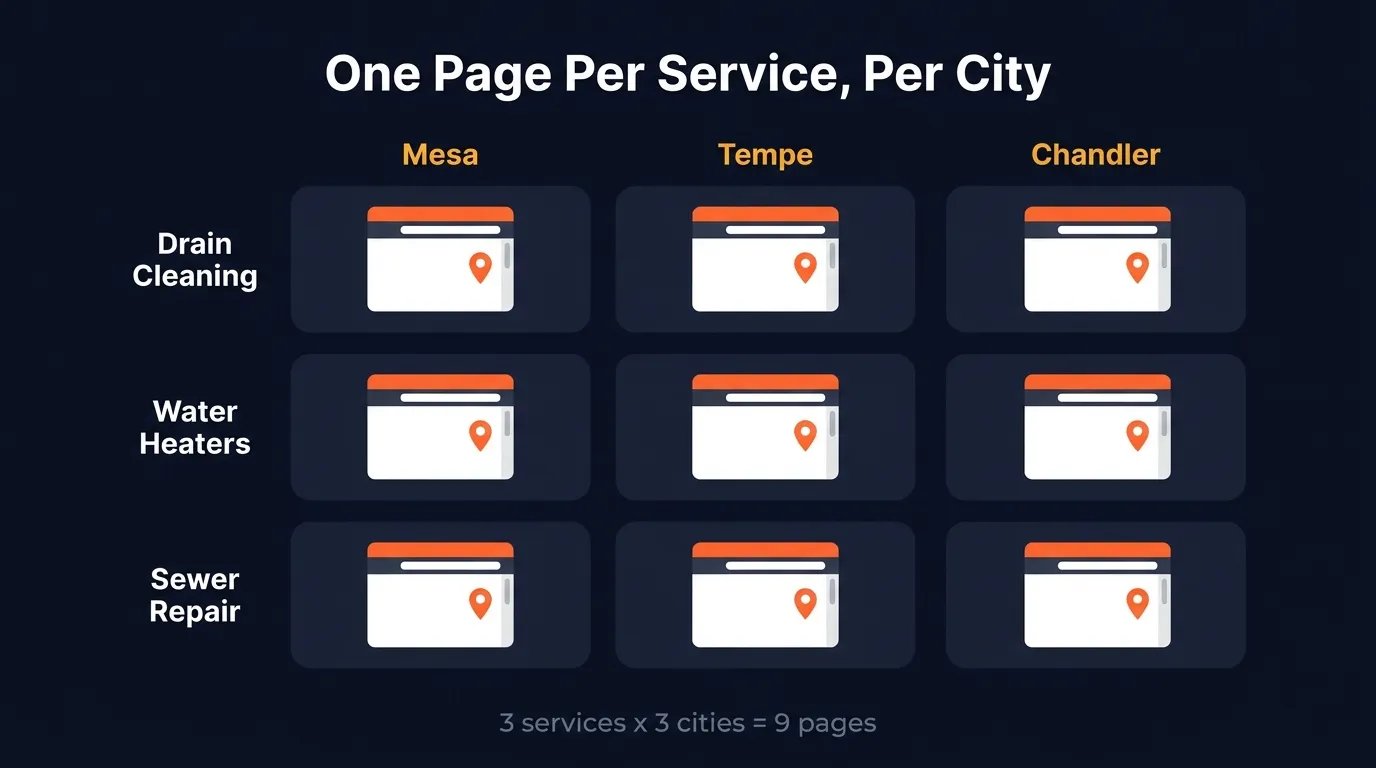 Three services in three cities is already nine pages. Most contractors have far more of both.
Across trades, that looks like:
- A plumber: drain cleaning, water heater repair, sewer line repair and repiping, each in Mesa, Tempe, Chandler and Gilbert.
- An HVAC company: AC repair, AC replacement, furnace repair and heat pumps, in each town.
- A roofer: roof replacement, roof repair, storm damage and gutters, in each town.
- A fence contractor: wood, vinyl, chain link and gates, in each town.
There is a real risk, and you should know it. Google’s spam policies call out doorway abuse, including “having multiple domain names or pages targeted at specific regions or cities that funnel users to one page.” A city page that only swaps the town name is exactly that kind of thin page.
So every page has to earn its spot with real details for that city: neighborhoods you work in, local housing stock (older cast iron drains, clay tile roofs), jobs finished there, photos from those jobs, and reviews from customers in that town. If the page could be copied to the next city by changing one word, it is not done.
When we audit a new contractor, the gap I see most is a profile that lists 15 services and a website with pages for three of them. The owner assumes Google knows they do furnace repair in the next town because it is on the profile. But the profile is a claim. The page is the proof. Once each service has a real page for each city they actually serve, the profile and the site finally say the same thing, and that is when rankings outside the shop’s own neighborhood start to move.
That is why the Ignite website is built with up to 250 pages: a dedicated page for every service in every city the business serves, written around the terms people in those towns actually search, with every page submitted to Google for indexing.
What do citations and NAP consistency actually do?
Citations are listings of your business name, address and phone number (NAP) on other sites such as directories, Bing, Apple Maps and data aggregators, and keeping that NAP identical everywhere helps Google confirm your business is real and located where you say, while mismatched listings create doubt.
BrightLocal’s guide to NAP puts it simply: “Many citations with identical NAP information can signal to Google that what it knows about a business is correct.” The same guide cites research that 93% of consumers are frustrated by incorrect information on online directories, and 80% say they lose trust over inconsistent contact details.
Citations are not the ranking lever they were ten years ago. In the 2026 Whitespark survey, the report’s author noted that citations “lost about half a percentage point,” continuing a downward trend, while adding that views may be turning more positive for AI search visibility.
That last point matters. AI tools like ChatGPT and Gemini need to verify a business before recommending it, and consistent listings across Google, Bing, Apple and the major directories are part of how they do it. More on that in our guide on how to show up in ChatGPT.
Where contractors get burned:
- Old addresses from a shop you left years ago.
- Tracking numbers that replaced your main number on some listings but not others.
- Name variations like “Smith Plumbing,” “Smith Plumbing LLC” and “Smith Plumbing & Drain.”
- Duplicate listings from a previous owner or a lead-gen site that copied your info.
The fix is boring and worth it. Pick one exact version of your name, address and phone, make every listing match, and recheck on a schedule, because directories copy from each other and old errors creep back.
How much do reviews move local rankings?
Reviews move local rankings because Google names review count as part of prominence, and fresh reviews also decide whether a searcher calls you or the next company, so for contractors a steady weekly flow of recent reviews beats a big total that stopped growing a year ago.
Google’s ranking page is the starting point: prominence is “based on info like how many websites link to your business and how many reviews you have.”
The human side is where most of the money is. BrightLocal’s Local Consumer Review Survey 2026 found:
- 97% of consumers read reviews for local businesses.
- 74% want reviews written in the last three months.
- 47% will not use a business with fewer than 20 reviews.
- 89% expect the owner to respond.
- 45% now use ChatGPT or other AI tools for local recommendations, up from 6% a year earlier.
Read the recency number again. A plumber with 300 reviews, the newest eight months old, looks less active than a competitor with 90 reviews and five from this month.
What works for trades:
- Ask at the moment of relief. The water is off, the AC is blowing cold, the roof is tarped.
- Make it one tap. A text with a direct link right after the job.
- Ask every customer. Google’s review policy bars businesses from trying to “selectively solicit positive reviews from customers,” and bars incentives for reviews too.
- Reply to all of them. Short, specific, human.
- Keep it steady. A few a week beats 40 in one month and then nothing.
At Ignite, finished jobs turn into review requests automatically, so the flow stays steady without anyone on the crew having to remember.
How do you track local rankings street by street?
You track local rankings street by street with a geogrid, a grid of points laid over your service area where your map rank is checked from each point for each keyword, which shows exactly where you win and where you vanish in a way one search from your office never can.
Map rankings are not one number. Because distance is a core local factor, your rank for “AC repair” changes as the searcher moves across town. Whitespark’s article on reported versus manual rankings puts it well: “You can actually see block by block, how the local results are changing.”
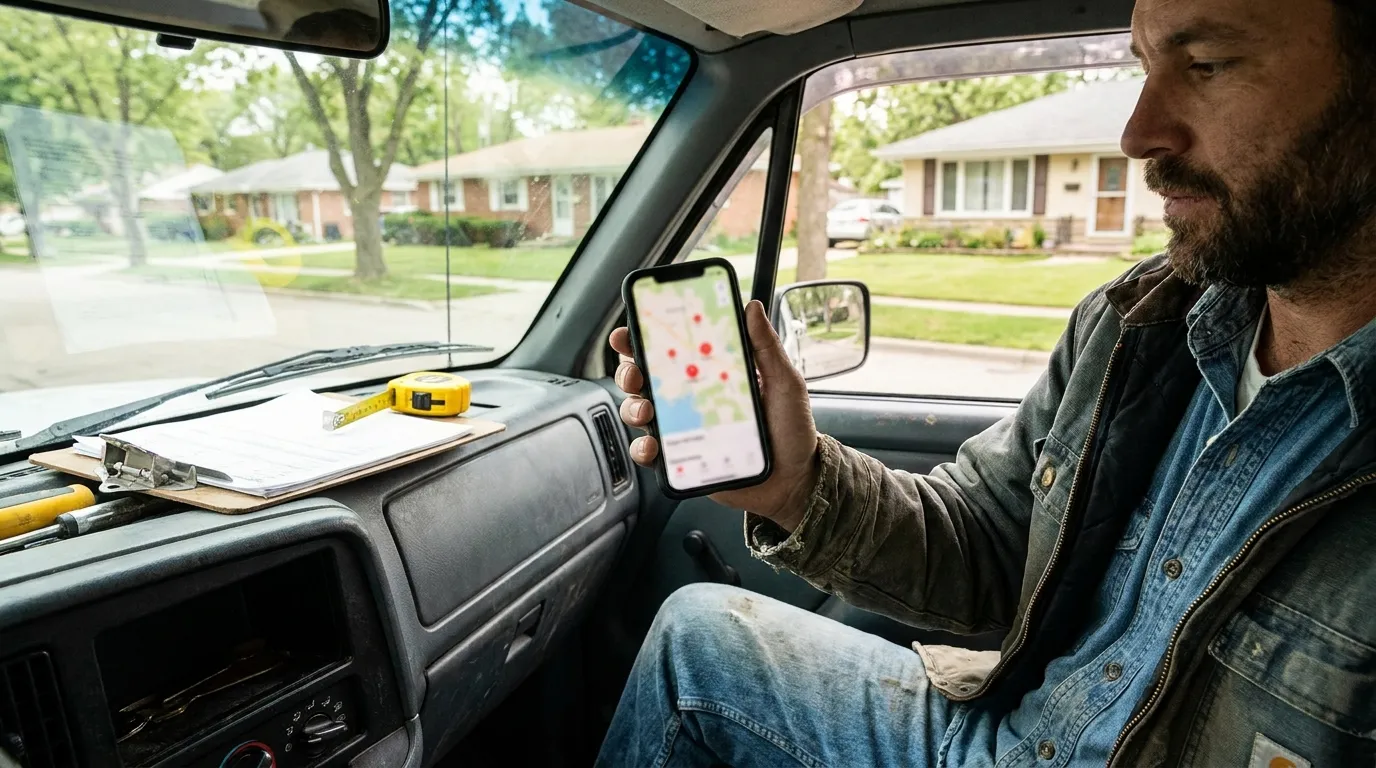 Searching your trade from your own truck shows one point on the map, not your whole service area.
The same article explains why your own phone misleads you. Your search uses your current location, while rank trackers set a precise location for each check. So “I searched and we were number one” usually means “we are number one near our office.”
A typical grid shows green near the shop, where you rank top three; yellow in the middle ring, where you show up below competitors; and red at the edges, in towns you want work from. That picture tells you where to work. If the red is in Gilbert, you need stronger Gilbert pages, more Gilbert job photos and reviews from Gilbert customers. Ignite tracks the grid for every keyword and city, so you watch it move instead of guessing.
How long until local SEO starts working?
Expect weeks for quick fixes and months for the bigger moves. Correcting categories, hours and listings can show up fairly fast. New city pages have to be crawled, indexed and trusted, and reviews build job by job, so the edges of the grid usually take several months of steady work to turn green. Anyone promising a fixed date or a guaranteed spot is guessing.
See where you rank on your own street
Local SEO for contractors is not a mystery. It is relevance, distance and prominence, built one proof point at a time: a complete profile, a page for every service in every city, listings that match, reviews that keep coming, and a grid that shows where you win and where you do not.
Those calls are only worth something if someone answers. My uncle once lost an $80,000 job over one missed call, which is why every Ignite plan includes a 24/7 AI receptionist alongside the ranking work. For how local SEO fits with ads and the rest of your marketing, read our home service marketing guide.
If you want to see your own grid, Book a Strategy Call. We will pull up your business live, show where you rank today across your service area, and point out which services and cities are missing pages.