October 27, 2026
Home Service Marketing: What Works, What It Costs, and Why Calls Leak
Home service marketing that books jobs: which channels work, what to budget, why speed to lead wins, how reviews drive calls, and agency vs DIY.

TL;DR: Home service marketing works when you stack the channels homeowners actually use (your Google Business Profile, a local website, Local Services Ads, Google Ads, reviews and AI search) and then plug the leaks. Most shops do not have a traffic problem first. They have a missed call problem and a review problem. Answer every call fast, ask every finished job for a review, and track which channel each call came from.
Most home service owners I talk to think they need more leads. Some do. But when we pull up their call logs, a lot of the leads they already paid for went to voicemail, got a callback the next morning, or never turned into a review that would have brought the next caller.
That is why I think of home service marketing as a bucket. Google, ads and referrals pour calls in. Missed calls, slow callbacks and silent happy customers drain them out. Pouring faster into a leaky bucket just costs more.
This guide is the hub for everything we write about marketing a plumbing, HVAC, roofing, electrical, restoration or cleaning business. It covers which channels work, how much to spend, why the first business to answer usually wins, how reviews turn into calls, and when it makes sense to hire help.
I spent six years in the field as a restoration technician before I started building marketing systems for trades. So this is written for owners who read on a phone between jobs. Short sections, real numbers, and links to the sources so you can check them yourself.
What marketing actually works for home service businesses?
The marketing that works for home service businesses is the marketing that shows up when someone has a problem right now: the Google map pack, Local Services Ads, Google search ads, a website with a page for each service and city, strong recent reviews, and a listing AI tools can trust. Referrals and repeat customers fill in the rest.
A homeowner with a leaking water heater does not scroll social media looking for a plumber. They search, look at the top few results, read reviews, and call. Your marketing has to be in that moment.
Here is how the main channels stack up.
| Channel | What you pay for | How fast it works | What it needs from you |
|---|---|---|---|
| Google Business Profile | Your time (free to run) | Weeks to months | Right category, real photos, steady reviews |
| Local SEO website | Build and content | Months, then compounds | A page for each service in each city |
| Local Services Ads | Each valid lead | Days after verification | Licenses, insurance, answered phones |
| Google Ads (search) | Each click | Same day | Tight keywords, tracking, a budget |
| Reviews | Your process | Ongoing | Ask after every finished job |
| AI search (ChatGPT, Gemini) | Your consistency | Months | Matching listings everywhere, clear site facts |
| Referrals and repeat | Relationships | Slow but cheap | Follow up, maintenance plans |
Your Google Business Profile is the base layer. In Whitespark’s 2026 Local Search Ranking Factors report, the top factors for map pack rankings were your primary category and how close you are to the person searching, and “open at the time of search” jumped into the top five. Some of that you control. Some of it you do not.
That is where a website comes in. Local SEO for contractors means building a real page for each service in each city you serve, so a roofer in one suburb can still show up in the next town over where the map pack would not reach.
AI search is the newest layer and it is growing fast. In BrightLocal’s 2026 Local Consumer Review Survey, 45% of consumers said they now use AI tools like ChatGPT when looking for local businesses, up from 6% the year before. We cover what those tools check in how to show up in ChatGPT.
How much should a home service business spend on marketing?
Most home service businesses should budget roughly 6% to 12% of revenue for marketing, which lines up with the benchmarks the SBA cites, and lean toward the high end when growing, launching a new service or entering a new city.
The SBA’s guide to marketing budgets says plainly that “there’s no hard and fast answer.” The industry benchmarks it shares show business-to-consumer service companies spending about 11.8% of revenue, higher than most other types of businesses. It also suggests checking your trade association for numbers specific to your field.
A few ways to think about your number:
- Start from a revenue goal, not a gut feel. If an HVAC company does $2 million a year, 7% is $140,000, or about $11,700 a month across every channel, including people and software.
- Price your leads. LocaliQ’s 2025 home services benchmarks found an average cost per click of $7.85 and an average cost per lead of $90.92 on search ads, with roofing and gutters the highest at $228.15 per lead. Compare that to your average ticket and close rate.
- Split paid and owned. Ads stop the day you stop paying. Your profile, website and reviews keep working. A healthy budget funds both.
- Follow the season. A roofer after a hail storm and an HVAC company in a heat wave should spend more when demand spikes, not the same flat amount every month.
One more thing. Spend on fixing leaks before you spend on more traffic. A dollar spent answering calls you already paid for goes further than a dollar spent buying new ones.
Which channels bring the best leads: SEO, Google profile, LSA or Google Ads?
The best leads for most home service businesses come from the Google map pack and Local Services Ads, because those searchers want someone now and see your reviews before they call. Google Ads fills gaps fast, and local SEO lowers your cost per lead over time. The best mix uses all four.
Each one plays a different role.
Google Business Profile brings the highest intent calls for free. A plumber in the top three of the map pack for “emergency plumber” gets calls from people who already picked them off the map. The catch is it takes time, and proximity limits how far one listing reaches.
Local Services Ads sit at the very top of the page. Google says you are charged for each valid lead, like an answered call, a voicemail or a message, not for clicks, and low quality leads can be credited back automatically. Google is also moving LSA management into Google Ads as Performance Max campaigns with pay-per-lead goals, starting in August 2026 with trades like plumbing, HVAC, electrical, roofing and pest control. You still pay per lead, and verified status carries over. Our Local Services Ads guide walks through setup and lead disputes.
Google Ads (search) is the fastest dial you can turn. You can be live today for “furnace repair near me.” But you pay for every click, whether or not they call, so it needs tight keywords and real tracking.
Local SEO is the slow build. It takes months. But once a roofing company ranks for “roof repair” in ten nearby towns, those calls come in without a click charge.
The mistake I see most is going all in on one channel. Ads alone get expensive. SEO alone takes too long. The map pack alone tops out at the edge of your proximity. Layer them.
Why does speed to lead decide who gets the job?
Speed to lead decides who gets the job because a homeowner with a burst pipe or a dead AC calls the next company on the list the moment you do not pick up. In home services, the first business to answer usually books the work, so a missed call is a job handed to a competitor.
The research backs this up. A study published in the Harvard Business Review, “The Short Life of Online Sales Leads,” found that companies that tried to reach a lead within an hour were nearly seven times as likely to qualify it as companies that waited even one hour longer, and more than 60 times as likely as companies that waited a day or more.
And most trades are not as fast as they think. A Service Direct study, reported by MightyCall, found local home service companies believed they answered 97% of their calls. They actually answered about 66%.
This one is personal for me. My uncle lost an $80,000 job over one missed call.
That is the leaky bucket in one sentence. Here is how to plug it:
- Answer every call, every hour. Nights and weekends are when pipes burst and furnaces quit. Use an answering service, a dispatcher, or an AI receptionist that can book the job.
- Call back missed calls in minutes, not hours. Set up an instant text back so the caller knows you saw it.
- Know your answer rate. Pull your phone logs once a week. If you do not know the number, it is probably worse than you think.
- Track every call by source. Use call tracking numbers so you can see whether a call came from your profile, your website, LSA or Google Ads. Without that, you are guessing which channel to fund.
When we take over a new account, the first thing I look at is not rankings. It is the phone log. Again and again we find calls from the busiest hours that rang out, callbacks that happened the next day, and nobody who knew which ad or listing the caller came from. Fixing that costs less than any ad budget, and it makes every other channel worth more. In my years as a restoration tech, the jobs we lost were almost never to a better company. They went to whoever picked up first.
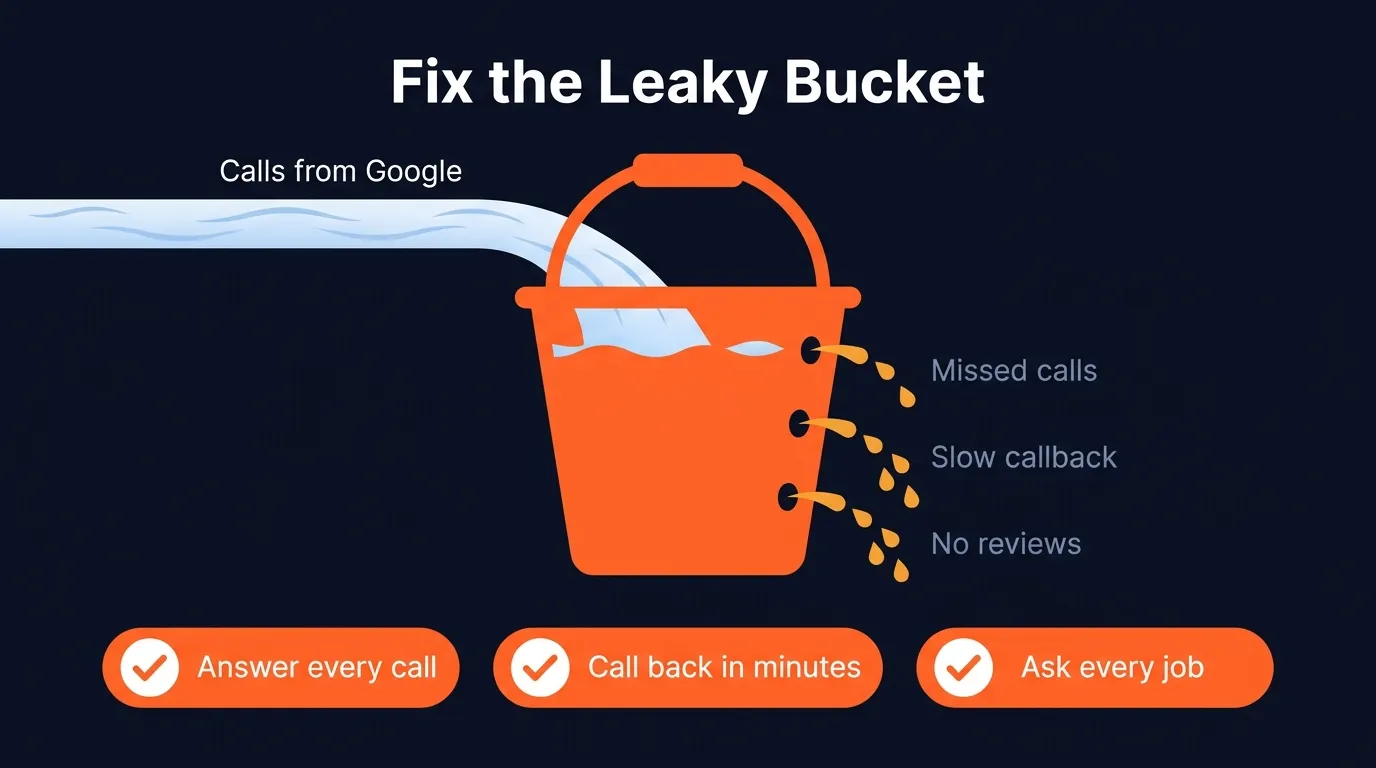 More traffic does not help if calls leak out the side. Plug the holes first.
How do reviews turn into more calls?
Reviews turn into more calls because most homeowners read them before they pick up the phone, and many will skip a business with too few, too old or too low reviews. More recent reviews also help you rank higher in the map pack, so the same reviews win you both visibility and trust.
The numbers from BrightLocal’s 2026 Local Consumer Review Survey are hard to ignore:
- 97% of consumers read reviews for local businesses.
- 47% will not use a business with fewer than 20 reviews.
- 68% want at least a 4 star rating, up from 55% a year earlier.
- 74% focus on reviews from the last three months.
That last point matters most. A roofer with 200 reviews and none since spring looks less active than a competitor with 60 reviews and five from last week. Recency is a signal to customers and, in Whitespark’s ranking research, reviews are one of the biggest groups of map pack factors.
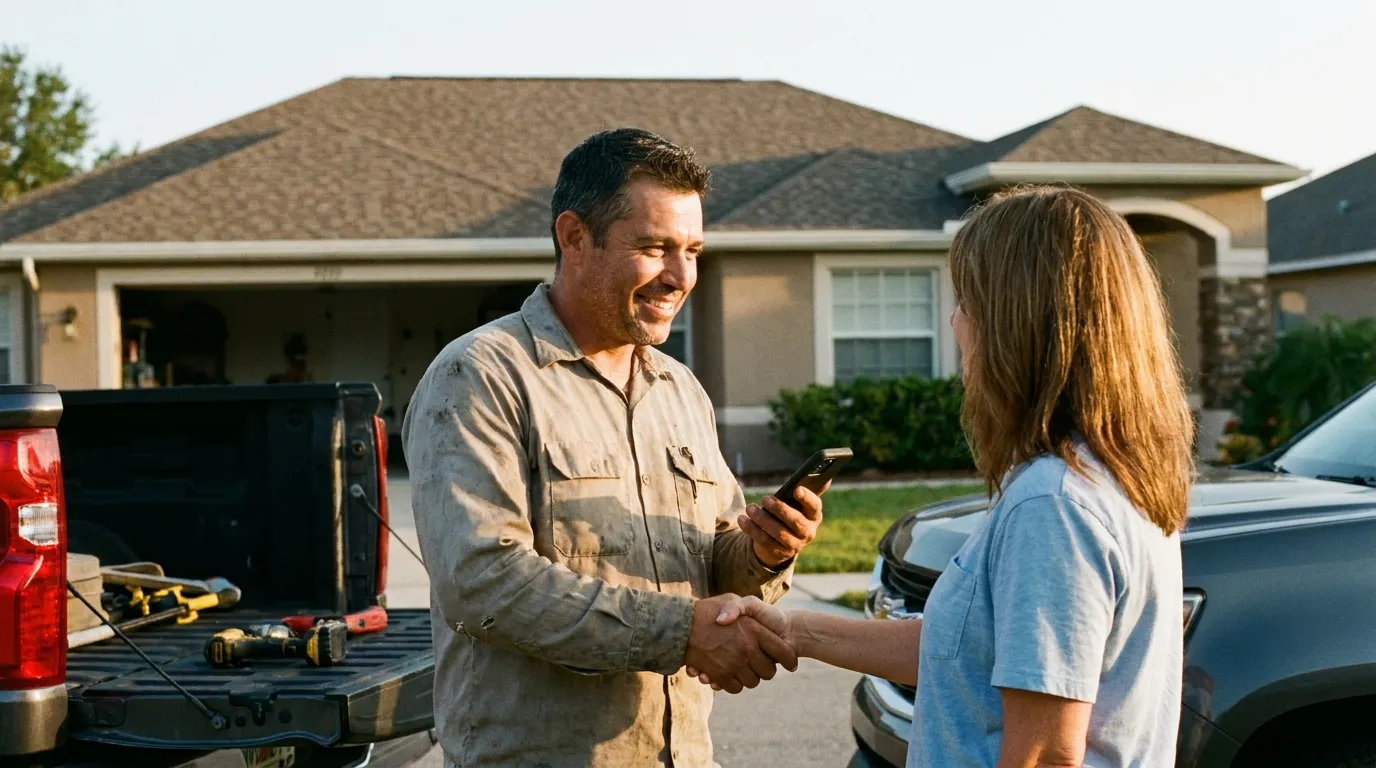 The best time to ask for a review is right after the job, while the homeowner is still happy.
The fix is a process, not a campaign:
- Ask every finished job. Send a text with a direct link right after the work is done. The tech can mention it on site.
- Make it one tap. Link straight to your Google review form. Every extra step loses people.
- Reply to every review. Thank the good ones by name and job type. Answer the bad ones calmly with a fix.
- Keep it steady. A few reviews every week beats fifty in one month and then silence.
Ask everyone, not just the customers you think are happy, and never pay for reviews. Google’s Maps content policy bans offering payment, discounts or free services in exchange for a review, and it bans selectively asking only happy customers.
Should you hire an agency or do it yourself?
You should do it yourself if you have the time to post weekly, build pages, manage ads and chase reviews, plus someone on your team who will actually do that work every single week. Hire help when the work keeps slipping, when ad spend is growing without tracking, or when you would rather be running jobs than running Google.
Here is an honest look at both.
| DIY | Agency or done-for-you | |
|---|---|---|
| Cost | Your hours plus tools | A monthly fee plus ad spend |
| Speed | Slow, fits around jobs | Faster, it is their full-time work |
| Skill | You learn as you go | Should already know the platforms |
| Risk | Things slip in busy season | Bad agencies hide the work |
| Control | Total | Depends on transparency |
If you go with an agency, ask these before you sign:
- Can I see every page, post, ranking and call? If they will not show you, walk away.
- Do you track calls by source? If they report clicks and impressions but not calls, they are measuring the wrong thing.
- Is there a long contract? Good work does not need to lock you in.
- Do you only work with home service businesses? A general agency learning your trade on your dime is expensive.
- Do you promise a number one ranking? Nobody can honestly guarantee that. Run if they do.
For context on what done-for-you looks like, Ignite runs the whole Google presence for $2,497 a month with no setup fee and no long term contract. That covers the website with a page for every service and city, Google Business Profile management, review generation, Google Ads and LSA management, AI search work, call tracking numbers, and a 24/7 AI receptionist that answers every call and books the job. We built it that way because the leaky bucket problem only gets solved when one team owns both the traffic and the phones.
Whether you hire us, hire someone else, or do it yourself, the order is the same: plug the leaks, then add traffic.
Start by plugging the leaks
Find out how many calls you answer, how fast you call back, and how many reviews you got in the last 90 days. Then look at where you rank in the map pack across your whole service area, not just from your shop.
If you want help with that, book a Strategy Call. We will pull up your business live, show you where it ranks today street by street, and point out the biggest leaks in your bucket. No pressure, just a clear picture of what is working and what is not.