October 27, 2026
How to Show Up in ChatGPT: A Local Home Service Business Guide to AI Recommendations
How plumbers, HVAC companies and roofers get recommended by ChatGPT, Gemini, Perplexity and Google AI Mode: data sources, listings, schema, reviews, audits.

TL;DR: ChatGPT, Gemini, Perplexity, Claude and Google’s AI answers recommend local businesses they can confirm across several sources at once: your website, your Google Business Profile, review sites and directories. There is no trick prompt and no magic file. Let the AI crawlers in, publish one page per service with plain facts, keep your name, address and phone identical everywhere, earn steady reviews, and check what AI says about you every month.
A homeowner with water under the sink used to type “plumber near me” into Google. Now a growing share of them ask ChatGPT instead. In BrightLocal’s 2026 consumer survey, use of ChatGPT and other AI tools for local recommendations jumped from 6% to 45% in one year, making AI the third most popular place people look for a business.
That is a big shift, and it has spawned a lot of bad advice. You will hear about secret prompts, special AI files and “GEO hacks.” Most of it is noise.
Here is what I see running Google profiles, sites and ads for home service businesses: AI assistants are cautious. They recommend the businesses they can verify, and they skip the ones whose facts conflict. So the work is not a trick. It is consistency and clear, structured facts, spread across the places these tools actually read.
This guide covers where each assistant gets local data, what your site needs, how reviews and listings fit in, the truth about llms.txt, and how to audit what AI says about you today. If you are newer to local search, start with our guide to local SEO for contractors, since most of this builds on it.
How do ChatGPT and other AI assistants pick which local business to recommend?
AI assistants pick local businesses by running a web or maps search behind the scenes, reading the top sources, and recommending the companies whose name, services, location and reviews line up across those sources. A business that shows the same facts on its site, its Google profile and trusted directories is easier to recommend.
Think of it like a homeowner asking three neighbors for a roofer. If all three name the same company, that is the one they call. AI works the same way, just faster and with more sources.
When someone asks “who is the best HVAC company in Mesa,” the assistant usually does not answer from memory. It rewrites the question into searches, pulls a set of pages and listings, and writes an answer from what it found. Then it cites a few of those sources.
That means you need to show up in the sources it reads, and those sources need to agree with each other. The 2026 Whitespark Local Search Ranking Factors survey added an AI visibility column for the first time. The local SEO experts it polled ranked “presence on expert curated best of lists,” “dedicated page for each service” and “quality of unstructured citations” (mentions of your business on other sites) near the top. Keep in mind that is expert opinion, not a measured test. But it lines up with what the source studies show.
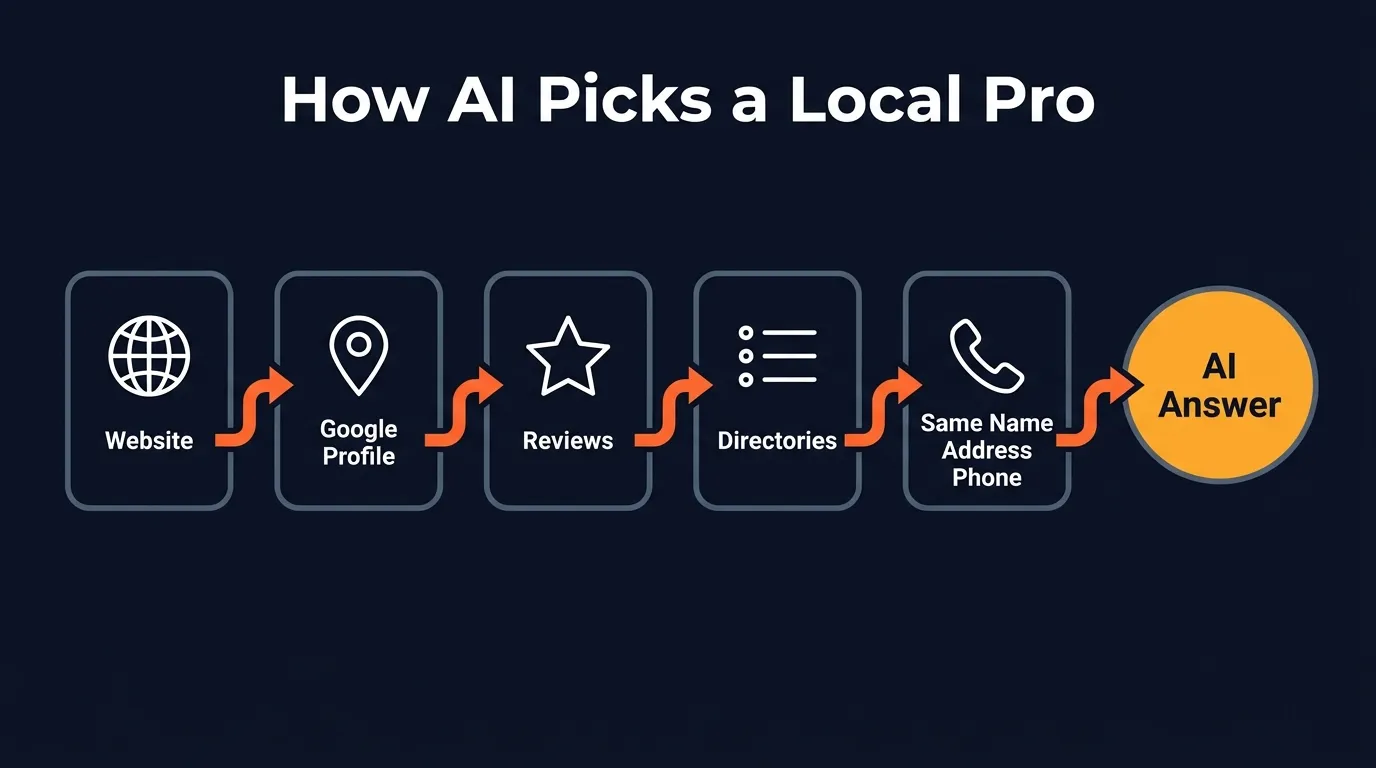 AI recommends the business it can verify in several places at once.
Where does each AI assistant get its local business data?
Each assistant leans on a different mix: ChatGPT blends its own crawler with outside search and licensed partners like Yelp, Gemini and Google’s AI Mode draw on Google’s index and Maps data, and Perplexity and Claude use their own search crawlers. Your website and listings feed all of them.
Here is what the public evidence says, tool by tool.
| Assistant | Main local data sources (what is documented) | What it means for you |
|---|---|---|
| ChatGPT | OpenAI’s OAI-SearchBot crawler, outside search providers, and licensed partners | Let OAI-SearchBot crawl your site; keep Yelp and directory listings accurate |
| Google AI Overviews and AI Mode | Google’s regular search index, per Google’s AI features guide | Normal Google SEO plus a strong Business Profile |
| Gemini | Google’s own data; Google already lets developers ground Gemini in Maps data on 250 million places, including reviews | Your Google Business Profile matters a lot |
| Perplexity | PerplexityBot, which Perplexity says surfaces and links sites in its answers | Let PerplexityBot crawl your site |
| Claude | Claude-SearchBot, which indexes pages for Claude’s search answers | Let Claude-SearchBot crawl your site |
A few honest notes on this table.
OpenAI does not publish a full list of where ChatGPT’s local results come from. One research team at Peec AI traced ChatGPT’s search traffic and found it pulls from OpenAI’s own index, services that scrape Google results, and licensed local partners such as Yelp and Tripadvisor. That is outside research, not an OpenAI statement, and the mix changes.
How fast it changes is the real lesson. In BrightLocal’s late 2024 test of 800 ChatGPT searches, business websites made up 58% of sources, mentions 27% and directories 15%, and Yelp did not show up at all. By BrightLocal’s August 2026 study of nearly 2 million AI citations, Yelp appeared in 80% of ChatGPT answers, and Google Business Profile was 28.5% of all citations across ChatGPT and Google’s AI tools.
So do not bet on one source. Be correct and consistent in all of them.
What does a home service website need so AI can read it?
A home service website needs to let AI search crawlers in, give every service its own page with plain facts, show the same name, address and phone as your Google profile, and mark up those facts with LocalBusiness schema. Clear pages get quoted; vague pages get skipped.
Here is the checklist I use.
- Let the search crawlers in. Check your robots.txt file (yoursite.com/robots.txt). OpenAI says sites that block OAI-SearchBot will not be shown in ChatGPT search answers. Anthropic says blocking Claude-SearchBot may reduce your visibility in Claude’s search results. Some website builders and security plugins block these bots by default. Note that GPTBot is different: it is OpenAI’s training crawler, and blocking it does not remove you from ChatGPT search.
- One page per service. A plumber should have a page for water heater replacement, a page for drain cleaning, and a page for sewer line repair. A roofer should have separate pages for roof replacement, storm damage and repairs. An assistant answering “who replaces tankless water heaters in Plano” looks for a page that says exactly that.
- Put the facts in plain text. Service area cities, hours, emergency availability, license number, years in business, brands you service, rough price ranges if you share them. Write them as sentences, not inside images.
- Match your Google profile exactly. Same business name, same address format, same main phone number in the footer of every page.
- Add schema markup. LocalBusiness structured data is code that tells machines your name, address, phone, hours and URL. Google’s documentation lists name and address as required, with telephone, hours, geo and URL recommended.
On schema, let me be straight. Google says there is no special schema you need to add to appear in AI Overviews or AI Mode. Schema is not a ranking hack. It is a clean way to state your facts so every machine reads the same thing. I treat it as part of consistency, not a shortcut.
 Before you chase AI, check that your site, profile and listings all say the same thing.
Do Google reviews and listings affect AI recommendations?
Yes, Google reviews and directory listings are among the main sources AI assistants read when they recommend a local business, because they are where the assistant confirms you are real, local and well reviewed. BrightLocal found Google Business Profile made up 28.5% of local AI citations, and Yelp showed up in 80% of ChatGPT answers in its 2026 study.
Your Google Business Profile is the single most important listing. Google’s own help page says more reviews and positive ratings can help your local ranking, and that businesses with complete and accurate info are more likely to show up. Since Google’s AI features run on the same search systems, a strong profile helps you in the map pack and in AI answers.
Then come the other listings: Bing Places, Apple Business Connect, Yelp, Facebook, the Better Business Bureau, and the trade directories in your niche. Each one is another witness. When they agree, AI trusts the story. When one says you are on Main Street and another says Oak Avenue, the assistant has a reason to pick someone else.
When we start with a new home service client, the most common problem is not missing listings. It is conflicting ones. We find an old phone number on Yelp, a former address on a directory from three moves ago, and a slightly different business name on Facebook. Nobody notices until they ask ChatGPT about their own company and it gets the hours or the phone wrong. Fixing those conflicts is boring work, but it is the work that makes AI confident enough to name you.
Reviews matter beyond the star count. AI reads what customers wrote. A review that says “they replaced our AC condenser the same day in Gilbert” tells an assistant your service, your speed and your city in one line. A steady flow of detailed reviews does more than a burst once a year. If you want the bigger picture on how reviews, calls and listings fit together, see our guide to home service marketing.
What is llms.txt and does a small business need one?
llms.txt is a proposed text file, placed at the root of a website, that gives AI tools a short summary of the business and links to its key pages, but it is not an official standard. It is optional, the major AI search engines have not committed to using it, and it only helps if it matches your site and listings.
The idea came from Jeremy Howard and was published at llmstxt.org in September 2024. It is written in simple Markdown: a title, a one line summary, and lists of links to important pages.
Here is the honest evidence:
- Google says you do not need to create “AI text files” to appear in AI Overviews or AI Mode.
- Ahrefs looked at 137,210 sites and found 97% of llms.txt files got zero requests. Their conclusion: if your goal is showing up in ChatGPT, Perplexity or AI Overviews, the file is “largely decoration.”
So why do we still add one for clients? Because it costs almost nothing, and for a local business it doubles as a clean fact sheet: services, cities, hours, phone, license. If an AI agent ever does read it, it finds the same facts as everywhere else. Just do not expect it to move the needle on its own, and be wary of anyone selling it as the secret.
How do you check whether AI recommends your business today?
To check whether AI recommends your business, ask ChatGPT, Gemini, Perplexity, Claude and Google’s AI Mode the questions your customers ask, from your service area, and record whether you appear, what each tool says about you, and which sources it cites. Repeat monthly.
Here is a simple audit you can run in 20 minutes.
- Write five real customer questions. Mix them up: “best emergency plumber in Tacoma,” “who installs heat pumps near Boise,” “roof leak repair same day Charlotte,” and one for your exact business name.
- Ask each assistant. Use a fresh chat or a logged-out window so past chats do not skew the answer. Results also change by location, so test from inside your service area if you can.
- Ask about yourself directly. “What do you know about [your business name] in [city]?” Check the phone, address, hours and services. Wrong facts are a listing problem you can fix.
- Look at the sources. Most tools show citations. Note which sites they cite for your competitors: Yelp, a “best of” list, the BBB, a trade directory. Those are the places you need to be.
- Write it down. A simple spreadsheet with the date, question, tool, whether you showed up, and sources cited. Answers vary from run to run, so trends over a few months matter more than any single answer.
If you run ads too, compare what AI says with what homeowners see in Local Services Ads. Both pull heavily on your reviews and your profile, so a fix in one place often helps the other.
How long does it take to show up in AI answers?
There is no reliable published timeline for showing up in AI answers, but assistants that search the web live can reflect site and listing fixes within weeks once their crawlers revisit your pages, while the facts baked into an AI model’s training update far more slowly. Plan on months, not days.
I want to be careful here, because the evidence is thin. No study I trust has measured “time to first AI recommendation” for local businesses. What we know is how the systems work. When ChatGPT, Perplexity or Claude search the web, they read the current version of your pages and listings, so corrections can show up as soon as their crawlers and partners catch up. Google’s AI features use the same index as regular search, so they move about as fast as your regular Google rankings.
What takes longer is the reputation side: reviews, mentions on other sites, and getting onto “best of” lists. Those build week by week. The businesses that win in AI answers are usually the ones already doing local SEO well, because the inputs are the same.
Want to see what AI says about your business?
Showing up in ChatGPT is not a separate game from Google. It is the same game, played across more sources, with less patience for messy data.
That is the approach we take at Ignite. Every client site gets schema markup on every page and an llms.txt file, and we keep listings and citations consistent across Google, Bing, Apple and the major directories, so ChatGPT, Gemini, Perplexity and Claude can verify and recommend the business. We pair that with the work that feeds AI in the first place: a page for every service in every city, Google profile management and a steady review flow.
No one can honestly promise you a spot in an AI answer. What we can do is make sure every source these tools read tells the same, accurate story about you.
Book a Strategy Call and we will pull up your business live, and show you where you rank on Google today.