November 20, 2026
Where to Open a Second Location: How to Pick the City for Your Next Google Business Profile
Where to open a second location for a home service business: the homeowner, income, home value and map competition numbers that pick your next city.
Part of our guide: google business profile for contractors
TL;DR: Don’t put your second location in the closest town. Put it in the town that scores best on five numbers: how many people live there and whether that’s growing, household income, the share of homes owned by the people living in them, home values and home age, and how weak the map competition is. Pull the free Census numbers, check the top three map results, score each city, then open a real, staffed office in the winner.
Every home service owner who’s outgrown one office wants the same thing: a second pin on the map that starts ringing the phone fast. More of the metro, more calls, more jobs booked from towns you can’t win today.
Most owners pick the spot the easy way. The town next door. The town where they live. The town where a buddy has cheap warehouse space. Then they spend a year fighting four competitors with 600 reviews each for a market full of renters.
The city you pick decides how hard every step after it will be. Pick a town full of homeowners with older houses, solid incomes and a thin map pack, and the new profile has room to climb. Pick wrong and you’re paying rent on an office that never gets past the second page of the map.
This post gives you the exact numbers to pull, where to get them for free, how to size up map competition in ten minutes, and a simple scorecard to rank every city around you. This is part of our guide to Google Business Profile for contractors.
Why does the city you pick for your next profile matter so much?
The city you pick matters because a Google Business Profile ranks strongest close to its address. Your new office’s pin decides which homeowners see you first, how many of them own homes that need your work, and how many strong competitors you’ll have to pass to reach the top three on the map.
Google says local results are based mainly on relevance, distance and prominence, and that distance means “how far each business is from the customer who’s searching.” In Whitespark’s 2026 Local Search Ranking Factors, local SEO experts rated proximity to the searcher as one of the top two map ranking factors, right behind the primary category.
So your new pin isn’t just an address. It’s the center of a new ranking circle. Everything inside that circle is your new market. If that circle lands on 40,000 homeowners in 30-year-old houses, a plumber has a goldmine. If it lands on a downtown full of new apartments, the same plumber is fighting for landlord work.
There’s a second reason it matters: you only get one shot at each location. Google’s Business Profile guidelines allow one profile per location for service businesses with “separate service areas and staff” at each one, and the office has to be real. P.O. boxes and remote mailboxes “aren’t acceptable.” A coworking office only counts if it has clear signage and is staffed by your own people during business hours. That means a lease, a crew and trucks. You want that investment in the town that pays you back.
And once you pick, the profile has to be built right. We cover that in how to launch multiple Google Business Profiles. This post is about the step before that: choosing where.
Which numbers tell you a market is worth it?
The numbers that tell you a market is worth it are population and its growth, median household income, the owner-occupied housing rate, median home value and the age of the homes. Together they tell you how many people can hire you, can afford you and own a home that needs your trade.
All of it is free from the Census Bureau. QuickFacts gives you a one-page snapshot for every county and for cities and towns of 5,000 people or more. The Census Business Builder puts demographics, income, consumer spending and business counts on one map, down to the ZIP code.
Here’s what to pull for each candidate city and why it matters:
| Number | Where to find it | Why a home service business cares |
|---|---|---|
| Population | QuickFacts | More households, more jobs |
| Population growth | Census city estimates | Growing towns add new homeowners every year |
| Median household income | QuickFacts | Can they afford a repipe or a new roof? |
| Owner-occupied housing rate | QuickFacts | Owners hire you; renters call the landlord |
| Median home value | QuickFacts | Higher values usually mean bigger tickets |
| Median year built | Census Business Builder or data.census.gov | Older homes break more often |
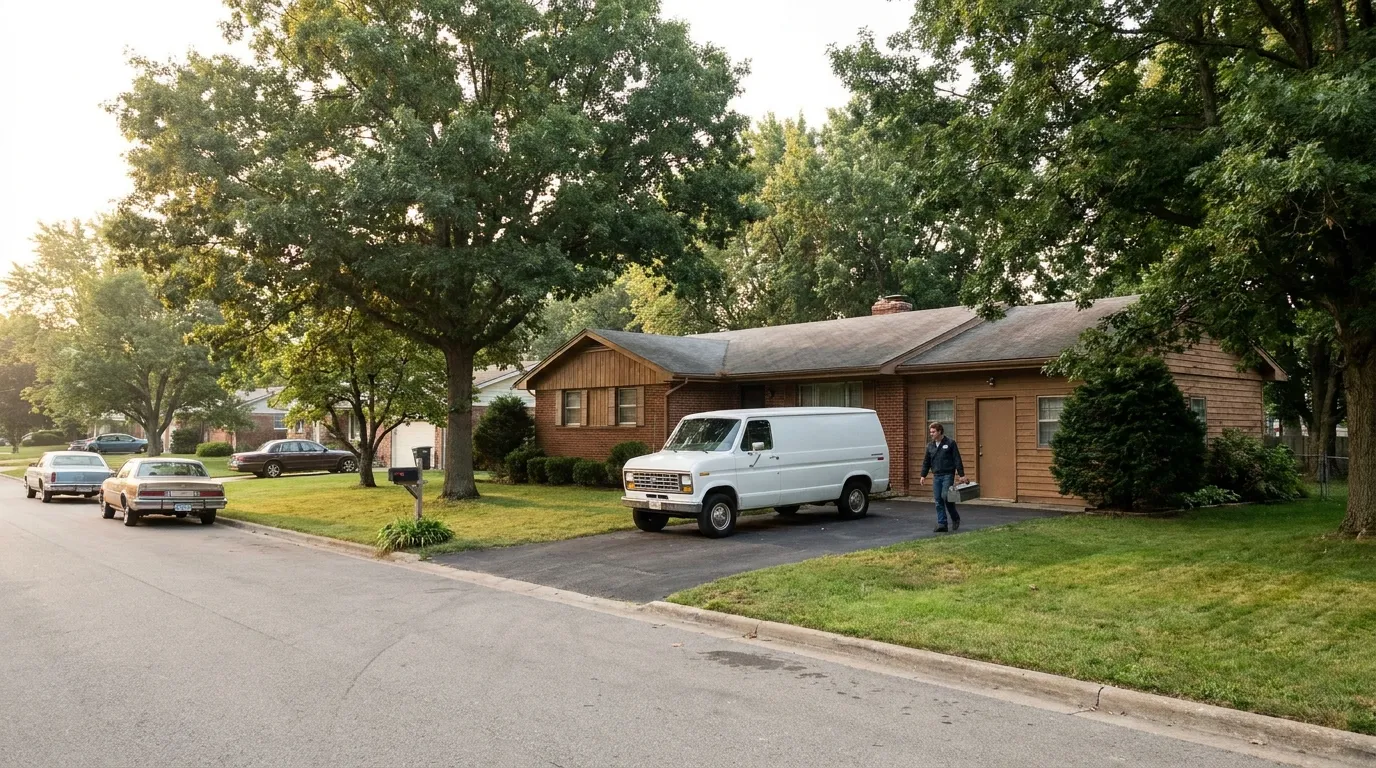 Owner-occupied homes that are 30 to 50 years old are where repair and replacement work lives.
A few of these deserve a closer look.
Owner-occupied rate. This is the one most owners skip, and it might be the most important. Census counts a home as owner-occupied when the owner lives in it. Those are the people who search “water heater replacement” at 10pm and pay the bill themselves. A town at 75% owners is a very different market than one at 40%.
Home age. NAHB’s analysis of the 2024 American Community Survey puts the median owner-occupied home at 42 years old nationally. It swings hard by state: 64 years in New York, 25 in Nevada. For a plumber, a roofer or a restoration company, older stock means more failing pipes, roofs at the end of their life and more water losses. For a fencing or remodeling company, a newer subdivision full of bare backyards can be the better bet. Match the housing to your trade.
Growth. The Census Bureau’s Vintage 2025 city estimates show where people are actually moving. The fastest-growing cities were mostly suburbs of big metros, led by Celina, Texas, at 24.6% in one year. The release even notes that Charlotte was only the seventh fastest-growing city in its own metro. The growth is often one ring out from the big city, which is exactly where a second office can land.
Income and value. The Harvard Joint Center for Housing Studies ties home improvement spending to the aging of homes and record-high property values. Its latest remodeling forecast projects spending growth slowing to about 0.5% by early 2027. In a flat market, you want your next office where incomes and home values give owners room to spend.
Search demand. Last, check what people actually search there. In Google Keyword Planner, set the location filter to the single city and pull volume for your money keywords: “ac repair,” “roof replacement,” “emergency plumber.” Google rounds these numbers, so use them to compare cities, not as exact counts.
How do you size up the competition on the map?
Size up map competition by searching your main service from the middle of the candidate city and studying the top three map results: how many reviews they have, their star rating, whether they have a real office in that city and whether they’re the same companies that win everywhere else.
Here’s the ten-minute version we run for every city:
- Search from inside the city. Open Google Maps, center it on the candidate town and search your top keyword, like “furnace repair.” Results change by where the searcher stands, so a search from your shop tells you nothing about a town 15 miles away. A geo-grid tool shows the same thing across dozens of points at once.
- Write down the top three. Name, review count, star rating and how recent the last review is.
- Check where they’re based. Is their address in this town, or are they ranking from the next city over? A top three full of out-of-town companies is a sign the town is under-served.
- Check their categories and websites. Do they have a page built for this city, or just a homepage? Thin websites are easy to beat.
- Count the field. The Census County Business Patterns data counts businesses by industry code in every county, such as 238220 for plumbing and HVAC or 238160 for roofing. It leaves out one-person shops with no employees, so treat it as the floor.
Then compare what you see to what customers want. BrightLocal’s 2026 consumer survey found 47% of consumers won’t use a business with fewer than 20 reviews, 68% will only use a business with four stars or more, and 74% look for reviews from the last three months. If the top three in a town have 35 reviews and nothing new since spring, a fresh profile with a steady weekly review flow has a real path to the top.
Here’s how to read what you find:
| What the top three look like | What it means for you |
|---|---|
| Under 50 reviews, few recent ones | Wide open. Strong pick. |
| Based in another town | Under-served. Strong pick. |
| 100 to 300 reviews, active | Winnable with time and steady reviews |
| 500+ reviews, local office, city pages | A long fight. Look elsewhere first. |
When owners ask us where to open next, they almost always name the town closest to the shop. When we pull the numbers and run a street-by-street grid, the winner is usually a town or two further out: more homeowners, older houses and a top three that’s thin or ranking from somewhere else. The closest town often already has the heavy hitters camped in it. Santino Velci
How do you rank the cities around you?
Rank the cities around you with a simple scorecard: give each candidate city a score from 1 to 5 on market size and growth, household income, owner-occupied rate, home value and age, map competition, and fit with your current service area, then add them up and start with the highest total.
You don’t need fancy software. A spreadsheet works. Here’s the setup:
- List every city inside your reach. Google says a service area “shouldn’t be more than about 2 hours of driving time” from the office, per its service area rules. Stay well inside that.
- Cross off cities your current profile already wins. Run a grid on your existing profile. Where you’re already top three, a new office only splits your own calls. The edge where your rankings fade is the hunting ground. We cover that fade in how to rank on Google Maps in multiple cities.
- Pull the five numbers for each city that’s left.
- Score each one 1 to 5. Grade each city against the others on your list, not against the national average.
- Double the competition score. Demographics tell you the prize. Competition tells you whether you can win it. We weigh it heaviest.
- Add it up and sort. The top two or three cities are your shortlist. Now go drive them.
Here’s what a scored list can look like. These are made-up towns to show the method, not real data:
| Factor | Town A (next door) | Town B (20 min out) | Town C (45 min out) |
|---|---|---|---|
| Size and growth | 4 | 4 | 5 |
| Household income | 3 | 4 | 3 |
| Owner-occupied rate | 2 | 5 | 4 |
| Home value and age | 3 | 4 | 3 |
| Map competition (x2) | 2 x2 = 4 | 4 x2 = 8 | 3 x2 = 6 |
| Fit with current area | 2 | 5 | 3 |
| Total | 18 | 30 | 24 |
Town A is the one most owners would pick. It’s close, so it overlaps the service area you already win, it’s renter-heavy and the map is crowded. Town B wins on almost every line.
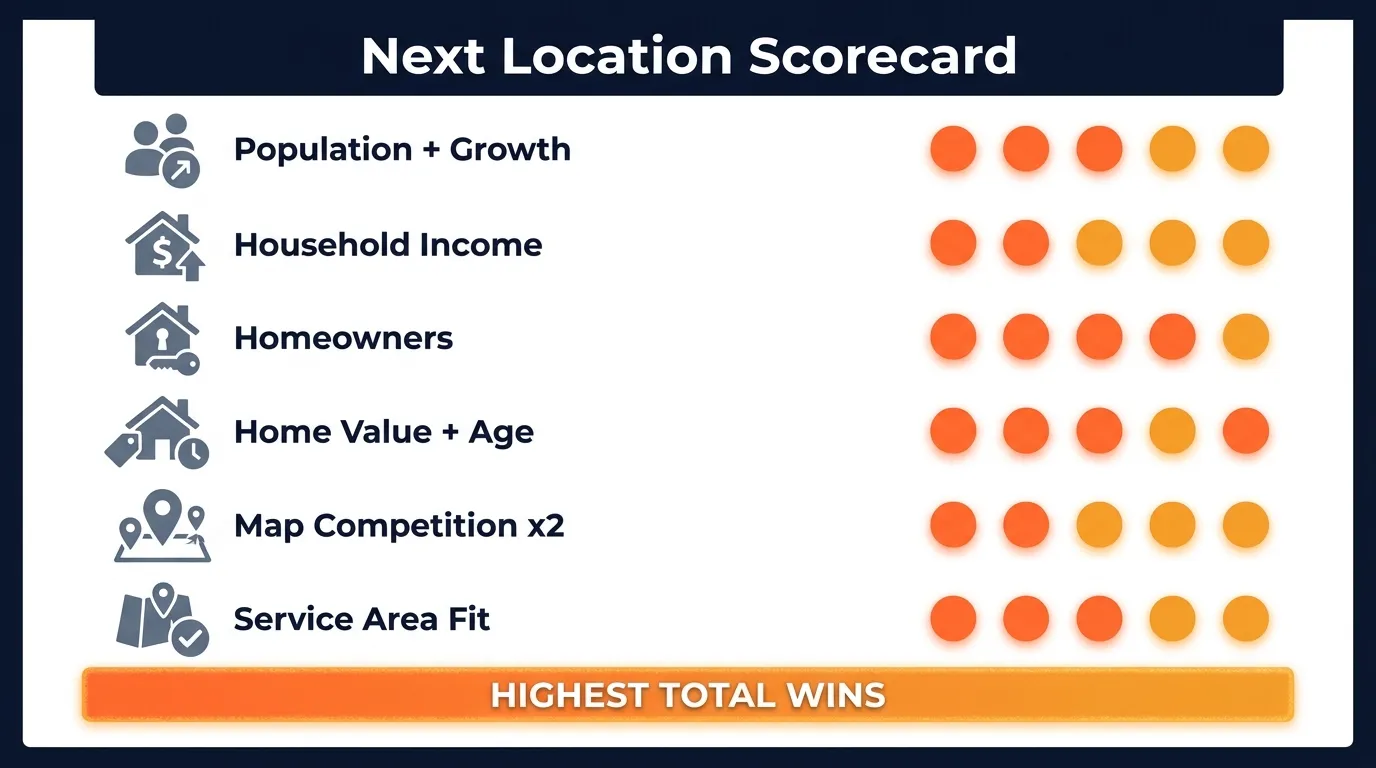 Score every city the same way. Competition counts double.
One more thing for step 2: plan the split. Google lets each profile list up to 20 service areas. Give the new office its own towns and take those towns off the old profile, so no city shows up on both. Whitespark’s experts flag overlapping service areas on multi-location profiles as a real suspension risk. Clean lines keep both profiles safe.
What does a strong next-location pick look like?
A strong next-location pick is a city with plenty of owner-occupied homes, incomes and home values that fit your tickets, a housing age that matches your trade, a top three on the map you can realistically beat, and enough distance from your first office that the two profiles cover different towns.
Here’s what that looks like in a few trades:
- A plumber wants the 1970s and 1980s neighborhoods with high homeownership. Galvanized pipes, original water heaters and slab leaks. A town where the top three plumbers are ranking from the next city over is gold.
- An HVAC company wants owners with the income to replace a whole system, in a town where a lot of homes are hitting the age when original equipment wears out. A growing suburb works too, since every new homeowner needs a maintenance plan.
- A roofer wants a big stock of homes old enough that their roofs are due, solid home values and a top three that’s still thin on reviews.
- A fencing company might flip the whole script and go after the fastest-growing suburb on the list, where new subdivisions are full of backyards without fences.
Before you sign a lease, run the last checks:
- Drive it. Visit the office space. Look at the neighborhoods around it. Make sure your crew can actually get to jobs fast.
- Confirm the office qualifies. Staffed during business hours, your own people, signage if it’s shared space, per Google’s guidelines.
- Plan the proof. Its own phone number, its own page on your site, its own job photos and a review request after every job. Every one of those is also a signal that helps AI tools like ChatGPT confirm the office is real, which we break down in how to show up in ChatGPT.
- Get a baseline. Run a grid of the new city before the office opens. That’s the scoreboard you’ll measure the new profile against.
Then launch it right, with the full playbook in how to launch multiple Google Business Profiles.
Find your next city before you sign a lease
Picking your next location is a numbers game, and the numbers are free. Homeowners, income, home value, home age and a map pack you can beat. Score every city the same way and the winner usually jumps off the page.
That’s the work we do for home service businesses at Ignite Systems. We build a profile and a page for every real office, run street-by-street rank tracking across your whole service area and keep the reviews and photos flowing, so each new location has a real shot at the map.
Book a Strategy Call. We’ll pull up your business live, show you where you rank today, street by street, and point out where your current profile fades out, so you can see where your next office should go.