November 10, 2026
Google Local Services Ads Cost: What Leads Really Cost Home Service Businesses in 2026
What Google Local Services Ads cost per lead by trade in 2026, what sets the price, how to find your real cost per booked job, credits and a starting budget.
Part of our guide: local services ads
TL;DR: A Google Local Services Ads lead costs about $60 on average across home service trades in 2026, with plumbing and HVAC near that line, electrical and painting cheaper, and restoration far higher. But the lead price is only the start. Your real cost is what you spend, minus credits, divided by the jobs you actually book. Answer every call and you can cut that number in half.
Every owner asks me the same first question about Local Services Ads: “What does a lead cost?” It is the right question to start with and the wrong one to stop at.
Google does not publish a price list. What you pay depends on your trade, your town, the type of lead and your bidding setting. The good news is that agencies and benchmark trackers now watch thousands of LSA accounts, so we have real numbers to work with.
Here is the part most cost guides skip. Two plumbers can pay the exact same price per lead and end up with costs per booked job that are hundreds of dollars apart. The difference is what happens after the phone rings: who answers, how fast, which job types are switched on, and whether anyone claims credits on junk calls.
This post covers what leads cost by trade right now, what moves the price, the simple math for your real cost per booked job, how to get money back on bad leads, and how much to budget to start. This is part of our guide to local services ads.
How much does a Local Services Ads lead cost by trade?
A Local Services Ads lead averaged $62.88 across 948 home service contractors in September 2026, according to one benchmark tracker, with most trades between about $25 and $80. Plumbing and HVAC sit near that middle, electrical, painting and landscaping run cheaper, and restoration runs far higher.
That September figure comes from The Data-Driven Trades, a benchmark newsletter that tracked $11.08 million in LSA spend and 174,083 unique leads that month. Two other sources fill in the trades it does not break out.
| Trade | The Data-Driven Trades (Sept 2026) | 99 Calls (Q1 2026) | The Media Captain (2025) |
|---|---|---|---|
| Plumbing | $67.05 | $56.90 | $69 |
| HVAC | $60.66 | $76.45 | $80 |
| Roofing | n/a | $65.80 | $162 |
| Electrical | about 26% below HVAC | $35.70 | n/a |
| Painting | n/a | $30.46 | $40 |
| Landscaping | n/a | $25.20 | $39 |
| Damage restoration | n/a | $194.00 | n/a |
| All home services | $62.88 | n/a | n/a |
The 99 Calls numbers come from its own Q1 2026 campaigns, a smaller sample of 3,367 leads. The Media Captain shared cost per lead from 100+ of its clients in 2025. The spread on roofing tells you something: one roofer in a storm market and one in a quiet suburb are not buying the same lead.
Use this table as a sanity check, not a forecast. If your plumbing leads run $140, something in your settings or market is worth a look. If they run $55, you are in the normal range and your profit lives in your booking rate.
How LSA compares with regular Google search ads
For context, LocaliQ’s home services search ad benchmarks put search ad cost per lead at $129.02 for plumbing and $228.15 for roofing. LSA leads usually come in cheaper because you pay per lead, not per click. That is why most of the home service businesses we work with run LSA for urgent, everyday jobs and save search ads for bigger tickets.
What sets the price you pay per lead?
Google says Local Services Ads lead prices vary by your location, the job type, the type of lead and your bidding mode. In practice, the busiest markets and highest value jobs cost the most, message leads usually cost less than calls, and your budget and bid setting decide how hard you compete.
That list comes straight from Google’s How leads work page. Here is what each one means for an owner.
- Location. A lead in a dense metro costs more than a lead in a small town. The Data-Driven Trades found the West was the most expensive region at $77 a lead in September 2026.
- Job type. A sewer line replacement lead costs more than a faucet repair lead. Every job type you switch on is priced on its own.
- Lead type. Google says “message leads are typically priced lower than the corresponding phone lead price, although that’s not always the case.” Message pricing also factors in how likely that customer is to book.
- Bidding mode. Google’s bidding guide explains that when similar businesses compete for the same lead, their bids set what that lead is worth.
- Your own quality. Google’s ad ranking page says responsiveness, reviews and profile quality affect where you show. A strong profile wins more of the auction without paying more.
Bigger budgets do not buy cheaper leads
This one surprises people. In the September 2026 data, contractors spending under $2,000 a month paid $42.73 a lead and $167 per paying customer. Contractors spending over $50,000 a month paid $75.84 a lead and $322 per paying customer. As you push for more volume, you start buying the more expensive leads in your market. Grow spend in steps and watch your cost per booked job at each step.
How do you figure your real cost per booked job?
Your real cost per booked job is your total Local Services Ads spend, minus any credits Google gives back, divided by the number of jobs you actually booked from those leads. It is the only LSA number that tells you whether the channel makes money, because it counts missed calls and junk leads.
Here is the math with real benchmark numbers. The Data-Driven Trades put the average book rate at 41.8% in September 2026. At $62.88 a lead, that works out to about $150 per booked job ($62.88 divided by 0.418).
Now run it for two HVAC companies paying the same $60 a lead on 100 leads a month, $6,000 total:
| Company A | Company B | |
|---|---|---|
| Leads | 100 | 100 |
| Spend | $6,000 | $6,000 |
| Booked jobs | 45 | 20 |
| Real cost per booked job | $133 | $300 |
Same market, same lead price, more than double the real cost. Company B is not paying Google more. It is losing jobs after Google already charged it.
 Your booking rate moves your real cost more than your bid does.
Where the money leaks
Three leaks show up again and again.
- Missed calls you still pay for. Google charges a missed call during your business hours if the caller stays on the line more than 20 seconds, per its lead charging rules. List hours you will really answer.
- Calls that never reach a person. In one graded sample of 23,031 leads, 8.6% were calls that hit an automated greeting or phone menu and never reached anyone. A phone tree on an emergency call is a paid lead you hung up on.
- Bookable leads that did not book. The same tracker found that 56% of bookable conversions still did not book. These were real customers with real jobs.
My uncle lost an $80,000 job over one missed call. With LSA, a missed call costs you the lead fee and the job, and Google’s ranking page says missed calls can hurt your responsiveness score too.
“When an owner tells me LSA is too expensive, I don’t open the bid settings first. I pull the call log. Nine times out of ten the lead price is normal and the problem is calls ringing out at lunch, voicemail after 5pm, and nobody calling back for two hours. Fix that and the same budget books a lot more work.” Santino Velci
Track every channel on its own number
You cannot find your real cost if you cannot tell where each call came from. Use separate tracking numbers for LSA, Google search ads and your Google Business Profile. If you run more than one location, give each office its own profile, number and page so you can see which one is earning. Our guide on how to launch multiple Google Business Profiles walks through that setup, and it matters for LSA too, since Google shows only your highest ranking ad when several of your locations serve the same area.
How do you get money back for bad leads?
You get money back for bad Local Services Ads leads through credits: Google reviews every lead, automatically credits ones its models judge invalid or low quality, usually within 30 days, and can add a bonus credit when you rate a lead. Leads for jobs or areas you do not serve are no longer credited.
That is from Google’s lead credits page. The old manual dispute button is gone, so the work has shifted to two places: your settings and your lead ratings.
How much is on the table? The Data-Driven Trades estimated that about $8.90 of every $100 in LSA spend lands on credit-eligible leads. The Media Captain says its clients typically get 6 to 7% back. On a $6,000 month, that is roughly $400 to $500.
Here is the weekly routine I recommend:
- Open the lead list every week. Not once a month. Credits work better when you rate leads while you still remember the call.
- Rate every lead. Go to Leads, open a lead and select “Rate this lead.” Google says feedback helps it send better matched leads and can earn a bonus credit.
- Flag the obvious junk. Spam, robocalls, sales pitches, wrong numbers and calls with no one on the line.
- Tighten job types and service areas. Since “job type not serviced” and “geo not serviced” are no longer credited, a plumber who leaves septic on, or a roofer who leaves a town 50 minutes away on, pays for those leads.
- Check your credits against your junk. If your lead list is full of spam and your credits are near zero, raise it with Google support.
One more tip for restoration and other high price trades. At $194 a lead in the 99 Calls data, one uncredited junk call costs more than a week of cheap painting leads. Rate those leads the same day.
How much should you budget to start?
Start with a weekly budget big enough for about 10 leads, which is Google’s own recommended minimum for Maximize Leads. At typical home service prices of $40 to $80 a lead, that means roughly $400 to $800 a week, held steady for at least a month before you judge it.
Google’s bidding guide recommends “a minimum budget of 10 leads per week for optimal results” and says it takes about two weeks for results to settle while the system learns your business. Here is how that works out by trade, using the benchmark prices above:
| Trade | Typical lead price | Starting weekly budget (10 leads) |
|---|---|---|
| Painting or landscaping | $25 to $40 | $250 to $400 |
| Electrical | $35 to $50 | $350 to $500 |
| Plumbing or HVAC | $55 to $80 | $550 to $800 |
| Roofing | $65 to $160 | $650 to $1,600 |
| Damage restoration | around $194 | about $1,940 |
For a reference point, the median contractor in one tracker’s same-store index spent $1,518 a week on LSA in September 2026. You do not need to start there.
Work backward from the job
Before you pick a number, figure out what a booked job is worth to you. If your average HVAC repair ticket is $500 and your real cost per booked job is $150, you are spending 30% of the ticket to get it. If that job often turns into a $9,000 system replacement down the road, the math looks very different. Know your average ticket, and decide the most you will pay per booked job, before you raise the budget.
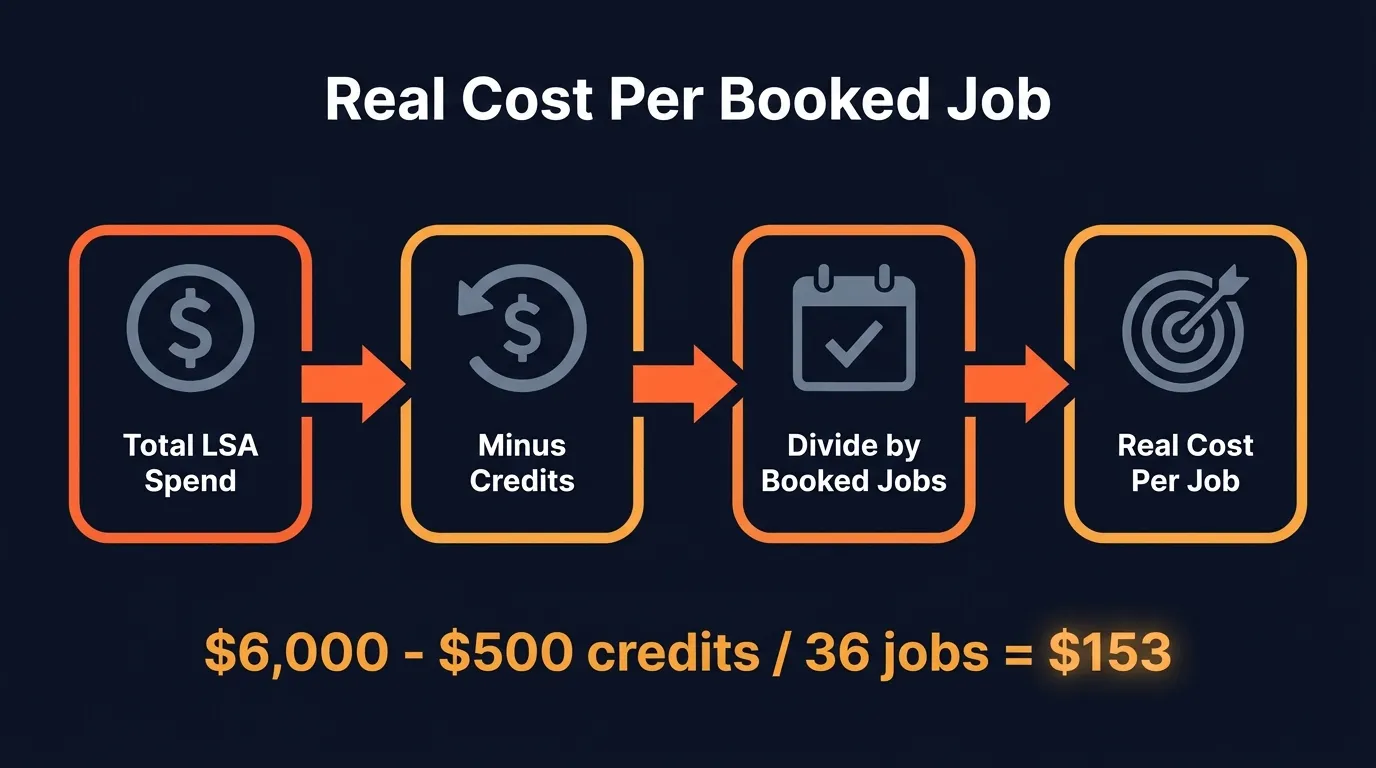 Spend, minus credits, divided by booked jobs. That is your real number.
A simple first month
- Switch on only the job types you want more of and the towns you will drive to.
- Set honest business hours and make sure someone answers every call in them.
- Set a weekly budget for about 10 leads on Maximize Leads.
- Rate every lead weekly.
- At day 30, calculate your real cost per booked job. Raise the budget only if that number works.
What changes about LSA cost when it moves into Google Ads?
When your Local Services Ads account moves into Google Ads, you still pay only for valid leads, but your weekly budget is divided by 7 into a daily budget, monthly spend is capped at the daily budget times 30.4, and manual bidding such as a max cost per lead goes away.
That is from Google’s migration notice. The move started in August 2026 for select US home service advertisers, with more groups following in late 2026 and into 2027. LSA becomes a Performance Max campaign with a pay per lead goal, and the ads still show only on Google Search and Google Maps.
What this means for your cost:
- Your budget math changes shape. A $700 weekly budget becomes $100 a day, with a monthly cap of about $3,040. Busy days can still spend more than $100.
- No more hard price cap. If you relied on Max Per Lead to hold prices down, that control goes away. Your settings, hours and answer rate become your main cost levers.
- One target across trades. Google Ads does not support vertical level Target CPA. An HVAC and plumbing company that wants different targets for each needs separate campaigns.
- Save your history now. Google says your old LSA performance reports will not transfer. Download them so you can compare cost per lead before and after.
- Your profile feeds the ad. Your Google Business Profile details sync into the campaign, so a sloppy profile shows up in your ads. Our Google Business Profile guide for contractors covers the fixes.
In Google Ads, the “Cost / conv.” column is your average cost per lead. It is still not your real cost per booked job. Keep doing that math yourself.
Want to know what your LSA leads really cost?
The businesses that win with Local Services Ads are not the ones paying the lowest price per lead. They answer every call, keep their job types and service areas tight, rate their leads every week and measure cost per booked job.
Ignite Systems manages Local Services Ads and Google Ads for home service businesses as part of one system: budgets, job types, service areas and lead disputes. You get call tracking numbers that show which channel each call came from, and a 24/7 AI receptionist that answers every call and books the job, so you stop paying for leads that ring out. It all sits next to your Google Business Profiles, website and local SEO, so you are not relying on paid leads alone.
Nobody can honestly guarantee you the top spot. What we can do is show you where you stand.
Book a Strategy Call and we will pull up your business live and show you where it ranks today.